
The 21st Sabbath Gate Mystery: Through the Fire of Truth


The Hidden Mystery of the 21st Sabbath Gate
The 21st Sabbath Gate brings us to a very different place in our journey. The number 21 opens several Hebrew pathways that prepare us for the examination ahead.
The twenty-first letter of the Hebrew alphabet is Shin (ש). Shin is traditionally associated with fire, and that imagery is especially important for this Gate. Fire illuminates. Fire tests. Fire refines. Fire purifies. It exposes what has been hidden and burns away what cannot withstand examination.
For this reason, the 21st Sabbath Gate requires us to take a fiery approach to our study. We are going to examine information closely, purify our understanding, clarify what we have learned, burn away illusion, and be willing to confront uncomfortable historical questions. Fire, in this Gate, becomes a resource for clarifying things. We are not entering the fire to destroy truth. We are entering the fire to discover what remains when everything that obscures truth has been burned away.
But 21 gives us another picture.
Resh (ר) is the twentieth letter of the Hebrew alphabet. Resh (ר), whose name means head, and for this study, we will examine the head as the place of the mind—the place of thought, understanding, perception, reasoning, and decision.
Then we add Aleph (א), the first letter of the Hebrew alphabet. Aleph carries the imagery of strength, power, and that which comes first.
Twenty (Resh) plus one (Aleph) brings us again to twenty-one.
Within the symbolic language of this Gate, Resh + Aleph gives us another picture: a strengthened mind—a mind prepared to think, examine, question, discern, and stand firmly in what it discovers to be true.
This is especially important because we did not arrive at the 21st Sabbath Gate with the same understanding with which we began this journey. Through the previous Sabbath Gates, our minds have been exercised. We have questioned, examined, searched, remembered, rediscovered, received, and transformed our understanding. Our thinking has been challenged. We have been learning to move beyond what we were told and examine what the Scriptures actually reveal.
Now that strengthened mind enters the fire.
But there is still another way to look at twenty-one.
The numerical value of Kaph (כ) is 20. When Kaph is joined with Aleph (א), we again arrive at twenty-one.
In the previous Gate, we discovered that Kaph represents the open palm—the hand prepared to receive, hold, and give. Aleph brings the imagery of strength and power. Together, Kaph and Aleph offer another way to enter this Gate: by being open to receiving power, strength, knowledge, and understanding.
The open hand now becomes more than a symbol of receiving. It reminds us to remain open as we examine what comes next. Our hands must be open to receive, but so must our minds. If we enter the fire already determined to hold tightly to everything we have previously believed, there is nothing new for us to receive. The 21st Sabbath Gate therefore asks us to enter with the strength to examine and the openness to receive whatever truth the examination reveals.
And then there is the number 21 itself: three sevens—7 + 7 + 7.
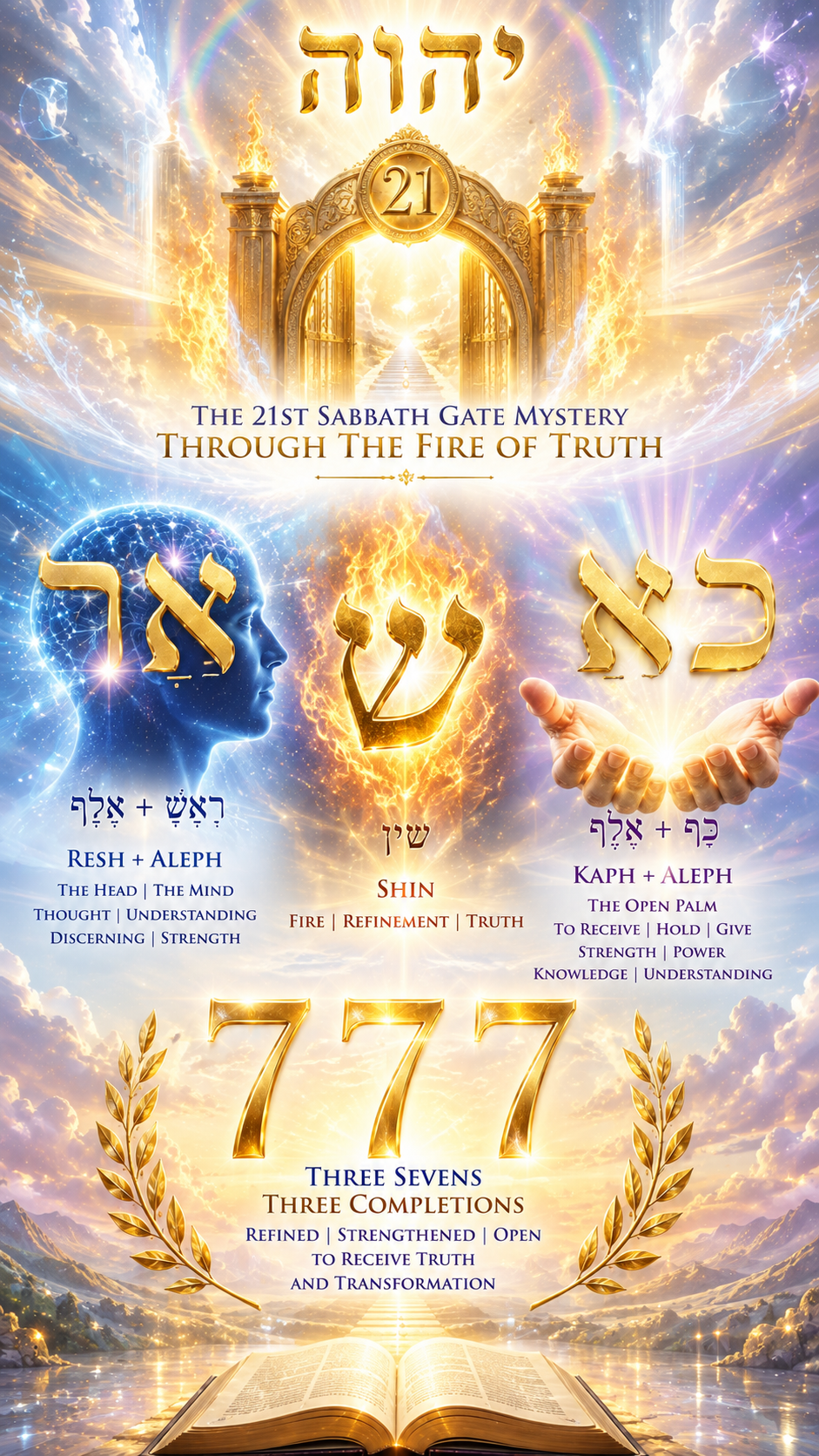
Throughout this Sabbath journey, seven has continually brought us back to completion, the seventh day, and the order Yahweh established from the beginning. Twenty-one gives us that seven three times. Symbolically, we can therefore approach this Gate through the imagery of three completions, bringing together three positions we will need for the journey ahead.
The first is the refining fire of Shin.
The second is the strengthened mind of Resh and Aleph.
The third is the open reception of Kaph and Aleph.
Together, these three powerful images prepare us for the final examination of this Sabbath series. We enter with a mind strengthened by everything we have learned, an openness to receive what the truth reveals, and a refining fire that is willing to test what we have been taught and burn away illusion.
We approach this examination with anticipation about what the fire will expose. We allow the fire to purify our thinking, strengthen our minds, and examine what remains as we open our hands and hearts to receive what is revealed, so that the truth becomes clearer and clearer.
This is what the 21st Gate brings to our Sabbath journey: the fire to purify, the strength of mind to examine, and the openness to receive.
So, let us walk through this 21st Sabbath Gate by returning to the question we deliberately left waiting for us since the beginning of this Sabbath journey:
Why would anyone want to change time?
We will discover the answer in this - 21st Sabbath Gate Mystery: Through the Fire of Truth
The Changing of Times and Laws
The question before us is:
Why would anyone want to change time?
To begin answering that question, we return to the writings of Daniel.
Daniel was a Hebrew prophet from Israel who was taken from Jerusalem into Babylonian captivity. His writings contain visions concerning kingdoms, rulers, judgment, and events extending beyond his own lifetime. In one of those prophetic visions, Daniel describes a power that would attempt something extraordinary:
“And he shall speak great words against the most High, and shall wear out the saints of the most High, and think to change times and laws…”— Daniel 7:25 (KJV)
Notice the wording carefully.
Daniel’s prophecy specifically speaks of an attempt to change times and laws.
For this Sabbath, we look at history to determine whether anything resembling this ever occurred. However, to gain clarity of this scripture, we must first understand exactly what Daniel said and meant.
What does it mean to change?
What are times?
And what are laws?
What does it mean to change time?
What does it mean to change laws?
Once we understand the words of the prophecy, we can turn to the historical record and ask the fiery question this Gate requires us to ask:
Did it happen?
And perhaps the greater question standing behind both of them is this:
Why would anyone want to?
What Does It Mean to Change Times and Laws?
Notice the wording carefully. Daniel’s prophecy specifically speaks of an attempt to “change times and laws.” For this Sabbath, we will look at history to determine whether anything resembling this ever occurred. However, before we move forward, we must first clarify the words of the prophecy itself.
What Does It Mean to Change?
The first word we must understand is change. In Daniel 7:25, the language is Aramaic, and the word translated “change” comes from שְׁנָא — shenāʾ (Strong’s H8133). It carries the meaning of changing, altering, or making different. Therefore, Daniel is describing more than simply observing that something naturally changes over time. The prophecy speaks of an intentional attempt to make something different from what it had previously been.
The English word change carries the same basic idea. To change something is to alter its condition, character, position, course, form, or state so that it is no longer exactly as it was before. If something has been established in one order and someone changes it, a different order has been introduced. This distinction is important because Daniel does not say that times and laws would simply change. He says that this power would “think to change” them. The wording introduces intention—the thought, purpose, or attempt to alter something already established.
What Are Times?
The Aramaic word translated “times” in Daniel 7:25 is זְמָן — zeman (Strong’s H2166). The word refers to time, a set time, an appointed time, or a particular occasion or season. This immediately adds depth to Daniel’s statement. A “time” is not limited to the ticking of a clock. It can refer to a designated point, period, season, or appointment within an established order.
This matters greatly within our Sabbath study because Scripture has already taught us that time has order. Genesis speaks of days, seasons, years, evening, morning, and the heavenly lights that mark them. The seventh day itself is a designated period of time. Therefore, when Daniel speaks prophetically about changing times, the word allows us to ask whether established or appointed periods of time could be altered, redefined, renamed, reassigned, or reorganized so that people begin measuring or recognizing time differently.
What Are Laws?
The Aramaic word translated “laws” is דָּת — dath (Strong’s H1882). It refers to a law, decree, regulation, statute, or established rule. A law establishes what governs conduct or order. It tells people what is required, permitted, prohibited, or recognized within the authority under which that law operates. Example: Remembering the Sabbath Day is a law.
Therefore, when Daniel brings time and law together, the prophecy presents two powerful areas of order: the ordering of time and the ordering of conduct. Time determines when. Law determines what is required.
If either is altered, behavior can change.
If both are altered together, an entire system of life can be redirected.
What Does It Mean to Change Time?
To change time, then, means more than changing the number displayed on a clock. It can mean altering the way time is identified, ordered, measured, recognized, or observed. A day can be renamed. A calendar can be reorganized. The beginning of a year can be reassigned. An appointed period can be attached to a different system of reckoning. A civil authority can establish when work will stop, when business will operate, or which days will receive official recognition.
This brings us directly back to the question that has followed us throughout this Sabbath journey. If Yahweh established an order for identifying the seventh day, and the Sabbath exists within that order, what happens when another system of time becomes dominant? The physical movement of the heavens does not have to change for man’s relationship to time to change. What must change is the system through which man identifies and organizes it.
What Does It Mean to Change Law?
To change law means to alter an established command, rule, decree, or governing requirement. This can happen by removing a law, replacing it, rewriting it, changing how it is interpreted, or establishing another rule that causes people to live according to a different standard.
This distinction becomes especially important when sacred law and civil law meet. A government may establish its own civil requirements, but the establishment of a civil law does not itself rewrite a command previously given by Yahweh.
Human authority can command people to behave differently. It can create customs, institutions, calendars, and official days; and over generations those practices may become deeply embedded within society. But that raises the question we must examine carefully: Can human legislation actually change what Yahweh established, or can it only change what people have been taught to recognize and observe?
Now the words of Daniel become much clearer. He prophesied of a power that would “think to change times and laws.”
And there is one more important expression in Daniel’s prophecy that we cannot overlook: the phrase “think to.”
The Aramaic word translated “think” is sebar (סְבַר, Strong’s H5452). It carries the meaning to think, intend, purpose, consider, hope, or expect. This knowledge adds another important dimension to the prophecy because Daniel does not describe something that happened by accident or developed without intention.
The language describes a deliberate purpose. There was an intention to change times and laws and an expectation that such a change could be accomplished.
Now the words of Daniel have become much clearer.
When Daniel prophesied that this power would “think to change times and laws,” he was describing an intended alteration of time and laws. To change that which had already been established. To think of changing means there was a purpose in making something different from what it had been before. They intended to alter the established times—the appointed or designated periods. And they intended to alter the established laws—the governing requirements. They hoped and expected that these changes could be accomplished.
This phrase therefore describes an attempted alteration of Yahweh’s established order involving both when and what—the times concern when something is appointed, recognized, or observed. The laws concern what is commanded and required. The prophecy is not simply describing change; it is describing the intention to produce change.
Only after understanding the complete expression “think to change times and laws” will we truly understand this phrase.
We place Daniel’s prophecy beside the historical record and ask the fiery question required by the 21st Sabbath Gate:
Did it happen? Did time change?
And perhaps the greater question standing behind it is this: Why did it happen, and why would anyone want it to?
Did It Happen?
To answer this question, we must dive into the history of modern humanity and examine what was changed, how it was changed, who made those changes, and what those changes actually accomplished.
The system of time recognized throughout much of the world today has a history. The calendar, the organization and naming of the days of the week, the designation of civil days of work and rest, and the ways governments and religious institutions have regulated the observance of time developed through centuries of decisions, laws, customs, and reforms.
Therefore, to determine whether times and laws were changed, we must follow the historical record itself.
Let us begin this search.
First, We Must Establish Yahweh’s Order
Let’s first establish the order presented in Scripture.
Within Yahweh’s weekly order, the days are identified by their numerical position: the first day, the second day, the third day, and so forth. The seventh day is also identified numerically, but something different happens with this day. The seventh day is given a designation that the other days do not receive. It is given a name: the Sabbath.
Scripture repeatedly preserves this distinction. Exodus 20:10 declares, “But the seventh day is the sabbath of Yahweh thy Elohim (God).” The seventh day therefore has both a numerical position and a sacred identity. It is the seventh day, and it is the Sabbath of Yahweh.
This is important information because Yahweh’s order does not begin by assigning a permanent name to each day of the week. The days are recognized according to their position within the sequence, while the seventh day is distinguished as the Sabbath. Therefore, we must keep the original biblical pattern clearly in mind: numbered days leading to the seventh day—the Sabbath of Yahweh.
From Numbered Days to Named Days
What do we know? Yahweh established a seven-day system of divine timekeeping. The days were numbered according to their position in the cycle, from the first day to the seventh day. Also, the seventh day was the only day given a special designation. It was called the Sabbath of Yahweh.
The Scriptures repeatedly show that this system operated through periods of seven.
In Exodus 16:26, Israel was instructed, “Six days ye shall gather it; but on the seventh day, which is the sabbath, in it there shall be none.”
Exodus 20:9–10 repeats the same order: “Six days shalt thou labour, and do all thy work: But the seventh day is the sabbath of Yahweh thy Elohim (God).”
Leviticus 23:15–16 even instructs Israel to count seven complete Sabbaths, resulting in a total of 50 days.
These passages make one thing very clear: the biblical system consistently operates through recurring periods of seven, with the seventh day identified as the Sabbath.
What we do not find in Scripture.
What we do not find in these Scriptures is a comma
Nor does the biblical text identify a person, ruler, decree, or moment when the Hebrew-Israelite method of counting the seventh day was officially changed into a fixed Saturday Sabbath.
Scripture continues to identify the Sabbath according to its position within Yahweh’s order: the seventh day.
The permanent identification of that seventh-day Sabbath with the weekday that would eventually be called Saturday appears within later historical systems of identifying and naming days. As different systems of timekeeping developed and interacted, the seventh day became associated with a fixed, recurring weekday.
The system of identifying days developed in the Greco-Roman world: the planetary week.
The seven days of the week became associated with seven celestial bodies recognized in ancient astrology. In its early ordering, the planetary week began with Saturn, followed by the Sun, Moon, Mars, Mercury, Jupiter, and Venus.
The early Roman planetary week, which appears in Italy in the late first century BCE, was an astrological system. Its sequence ran Saturn → Sun → Moon → Mars → Mercury → Jupiter → Venus, so in that particular ordering, Saturn’s Day came first and Venus’s Day came last.
As the seven-day planetary week spread throughout the Roman world, it coexisted with the recurring Sabbath practice already known among communities in Judea and throughout the eastern Mediterranean.
Here we see two different systems that mark the days differently: one uses numbers, the other uses planets.
The planetary week was originally a system for naming and ordering days according to astrological associations. The Romans did not originally establish one of these seven planetary days as a required weekly day of rest. Their traditional calendar contained festivals, religious observances, and civic holidays throughout the year. However, there was no Roman Sabbath-like rest day that automatically returned every seven days. The establishment of a Roman civil weekly rest day would come later.
It began like this. Roman writers became familiar with Sabbath observance by the 1st century BCE, and the earliest Roman evidence for the planetary week shows Saturn’s Day as being associated with the Sabbath very early on.
Here’s the distinction. Saturn’s Day was still the first day in the Roman calendar, not the seventh in the original planetary sequence. It means one system said, in effect, we will hold “Saturn’s Day as sacred and holy,” while the biblical system identified its holy day of rest as every “seventh day/Sabbath.”
Over time, Sunday, as the first numbered day of the week, became increasingly associated with Christian practice, while the planetary names continued to be widely used throughout the Roman West.
These two ways of identifying the week gradually became joined. The biblical/Christian ordering provided the sequence, beginning with its first day, and the older planetary system supplied the names of the days. This eventually produced the familiar arrangement in which the Sun’s Day became Sunday, the first day of the week.
There is no known single ruler, decree, or documented moment that moved Saturn’s Day from the first position to the seventh. The historical record shows the gradual merging and standardization of different systems until the seven-day week came to be recognized in this way.
That is how the familiar sequence Sunday, Monday ... Saturday developed: Sunday occupied the first position of the biblical/Christian ordering while the old planetary names remained attached to the recurring days. Saturn’s Day became Saturday, the seventh day of their system.
Even though their days were organized into a seven-day cycle, the Romans still did not have an empire-wide weekly rest day. However, early Christians increasingly gave that first day special significance.
Christians had already begun gathering on the Lord’s Day, or Sunday, and there is evidence of Christian Sunday rest before the fourth century. This was part of their Christian religious practice rather than Roman civil law.
That distinction would change dramatically in 321 CE.
The Year 321 CE: Constantine and the Day of the Sun
Constantine I was the Roman emperor who, during the early fourth century, issued a civil law concerning the Day of the Sun. On March 7, 321 CE, Constantine ordered:
“On the venerable Day of the Sun, let the magistrates and the people residing in cities rest, and let all workshops be closed.”
Notice exactly what happened.
Constantine did not, and could not, rewrite the Fourth Commandment. He did not change the words of Exodus. He did not go back into Genesis and change the seventh day that Elohim (God) had blessed and sanctified.
What Constantine possessed was Roman civil authority. He used his authority to establish the Day of the Sun as an official Roman civil day of rest.
This was a change in Roman civil practice. A recurring day associated with the Sun was now granted legal protection as a day on which magistrates, city residents, and workshops were instructed to cease their ordinary activities.
Constantine’s legislation therefore accomplished something significant in the history of Western timekeeping. Sunday observance was no longer only a religious practice among Christians or a day within the Roman planetary week. It now possessed the authority of Roman civil law behind it.
However, the Sabbath commandment, established by Yahweh, still read exactly as it had before Constantine:
“Remember the sabbath day, to keep it holy. Six days shalt thou labour, and do all thy work: But the seventh day is the sabbath of Yahweh thy Elohim (God)…”— Exodus 20:8–10 (KJV)
Yahweh’s commandment still identified the seventh day as His Sabbath.
From Yahweh’s Solar Count to the Roman Calendar
To understand another major change in the reckoning of time, we must return to the beginning of the year.
Yahweh established Abib as the beginning of the yearly cycle. Exodus 12:2 declares, “This month shall be unto you the beginning of months: it shall be the first month of the year to you.” Throughout the books of the law, months are repeatedly identified by their numerical order—the first month, the second month, the third month, and so forth. Abib is specifically identified as the month in which Yahweh brought Israel out of Egypt, and it marks the beginning of the yearly order.

The numbered months follow the same numerical pattern we have already observed with the days. Yahweh’s order is established through sequence. The first month is called Abib. After this, each month continues in numbered sequence through the yearly cycle.
The months are numbered, just as there is a first day, second day, third day, continuing until the seventh day—the Sabbath. Only the first month and the seventh day have names.
According to the solar-year system, Abib 1 marks the beginning of the new yearly count. It is day 1 in solar time. From that beginning, the days are counted continuously in sets of seven.
For example, if Abib 1 falls on Sunday in the Roman calendar in one year, then the seventh day falls on Saturday. If Abib 1 falls on Monday the following year, the seventh day falls on Sunday that year. If the next year Abib 1 falls on Tuesday, the seventh day will fall on Monday, and so on.
The seventh day itself has not changed. It remains Day 7.
What changes is the name of the Roman calendar weekday on which Day 7 occurs.
According to this system, the solar year governs the seven-day count. Each new year begins again with Abib 1 as Day 1, and the seventh day is determined by counting from that beginning. Therefore, the Sabbath remains permanently attached to its numerical position—seven—rather than permanently attached to a Roman weekday name.
The modern Roman calendar operates differently. It organizes the year from January 1 through December 31. The named weekday sequence—Sunday, Monday, Tuesday, Wednesday, Thursday, Friday, Saturday — is fixed and continues uninterrupted from one calendar year into the next. The weekly sequence does not restart on January 1. January 1 receives whichever weekday follows December 31.
This is the same for Abib 1. It also falls on a different weekday on the Roman calendar each year, causing the Sabbath to change each time.
The Roman calendar receives a new New Year’s Day, January 1, each year. In the Roman calendar, New Year’s Day falls on Friday, Saturday, Sunday, Monday, etc. It changes each year. You might even notice that, if you celebrate birthdays, anniversaries, or other dates, the day for these changes each year. They all change. But not the seventh day in their system. It is fixed to a named weekday instead of being determined by the yearly numerical sequence.
This creates two different ways of identifying the seventh day.
With solar time, Abib 1 begins Day 1, and the seventh day is recalculated from that beginning each year. But their seventh day is fixed.
This helps explain how Saturday became fixed in the minds of many people as “the seventh day.” Within the Roman calendar system, Saturday permanently occupies that position in the familiar Sunday-through-Saturday arrangement.
But within the solar count, the Sabbath remains the seventh numerical day, no matter which Roman-calendar weekday it falls on.
The Sabbath changes with each new solar year.
Along the way to this knowledge, we ran into another change that became apparent. You might have noticed that Yahweh’s yearly order begins with Abib as the first month, during the spring season of renewal. The modern Roman calendar instead begins the year on January 1 and ends it on December 31.
Now, when we ask the question, "What changed?" The answer is clear.
The ordering of the week has changed.
The ordering of the year has changed.
The day recognized by society has changed.
Yet the biblical instruction still remains:
“This month shall be unto you the beginning of months: it shall be the first month of the year to you.”— Exodus 12:2 (KJV)
Now we move on to discover the "why".
Why Would Anyone Want to Change Time?
Everything we have established throughout Sabbath Gates 18 through 21 brings us back to the question we have been carrying throughout this journey:
Why would anyone want to change time?
There are several levels to this question.
At the most basic level, time organizes behavior. The organization of time determines when people work, when they rest, when courts operate, when businesses open and close, when official holidays are observed, when communities gather, and when a society begins and ends its year. Whoever establishes the calendar establishes the rhythm by which an entire society moves. Changing the recognized organization of time, therefore, has the power to change the behavior of generations of people without changing every individual action.
But the question becomes much deeper when we consider everything we have learned about the Sabbath.
Throughout this journey, we have discovered that the seventh day is not simply a unit of time. The Sabbath is a sign of the covenant relationship between Yahweh and His people. It is the time Yahweh commanded His people to remember and keep. It is connected to sanctification, transformation, restoration, receiving, and becoming what Yahweh intended for us to be from the beginning.
Therefore, if people are separated from the time Yahweh designated, they also become separated from the practices, understanding, and meaning associated with that sacred time, called the Sabbath. This separation also includes Yahweh’s Divine appointment time.
You do not have to erase Yahweh from Scripture to accomplish this, although that was done too.
If you change the rhythm by which people continually return to Yahweh, eventually their relationship with that rhythm will change as well.
This makes the word remember extremely important.
Yahweh commanded:
“Remember the sabbath day, to keep it holy.”— Exodus 20:8 (KJV)
Why command His people to remember something and keep it?
Because something not remembered can easily be forgotten. And one way for something to become forgotten is for it to stop being kept.
Changing the way a people recognize time can therefore change what the next generations remember. Children born into a new system or a different way of doing things never experience it as a change. It is just that way to them. Then, as these children grow and their children inherit the same system, the new way is continually adopted.
Eventually, the grandchildren of the first people understand the changed way as the way time works. And even if there is an older generation around to explain that a change happened, it is too late—the habit and behavior have already become ingrained.
What one generation experiences as a change becomes the normal reality for every generation that follows.
There is also the question of authority.
A calendar is never simply a set of numbers printed on paper. Calendars tell society whose ordering system it recognizes. Throughout history, civil governments have exercised authority over calendars, workdays, taxation years, court days, and official holidays. Religious institutions have exercised authority over worship calendars and sacred observances. Changing the recognized system of time through a calendar can establish who possesses the authority to tell people when, what, and how something is to occur.
Then there is identity.
Shared time binds communities together. People who rest together, gather together, Sabbath together, worship together, celebrate holy days or holidays together, and begin their years together develop a collective identity and a collective consciousness. Their shared relationship with time becomes part of who they are.
Change the calendar, and over generations you can gradually change culture, collective memory, and spiritual identity. We do not have to speculate about a hidden mastermind to understand this effect. History provides many examples of governments and religious institutions standardizing calendars because common time creates social unity.
So now we move on to a deeper question.
If the Sabbath is connected to becoming, what happens when the time connected to the Sabbath and becoming is displaced?
Within the spiritual journey we have built throughout these Sabbath Gates, this question reaches the heart of everything we have discovered. Gates 19 and 20 revealed the Sabbath as a time associated with blessing, sanctification, transformation, receiving, restoration, and returning to the image of Yahweh. Therefore, disrupting that rhythm disrupts the recurring process Yahweh established from the beginning.
The Sabbath belongs to Yahweh. It is His Sabbath. Its purpose originated with Him, and the time was established by Him.
And this brings us back to the wording of Daniel’s prophecy.
Daniel did not simply say that times and laws would change. He said this power would “think to change times and laws.” As we discovered earlier, the Aramaic word for “think” sebar, carries the idea of thinking, intending, purposing, hoping, or expecting. The prophecy therefore contains intention. There was an intent to produce change.
So what was the intent?
This is where the portion of Daniel 7:25 that we deliberately held until now becomes extremely important:
“And he shall speak great words against the most High, and shall wear out the saints of the most High, and think to change times and laws...”— Daniel 7:25 (KJV)
Suddenly, the changing of times and laws is no longer standing on its own.
It appears within a larger picture of opposition against the Most High and the wearing down of His saints.
And that changes the question.
If Yahweh’s Sabbath is connected to remembrance, covenant, sanctification, transformation, restoration, receiving, and becoming, then changing the way people recognize that time can affect their entire relationship with Yahweh. And if the saints are to be worn out, interfering with the rhythm through which Yahweh gives them rest and restores them becomes especially significant.
The language “wear out the saints” is so powerful because it evokes a picture of exhaustion, oppression, pressure, and continual wear and tear.
Yet the Sabbath presents the opposite picture.
Exodus 31:17 says:
“It is a sign between me and the children of Israel for ever: for in six days Yahweh made heaven and earth, and on the seventh day he rested, and was refreshed.”— Exodus 31:17 (KJV)
One picture is wearing down.
The other is rest and refreshing.
This is why changing time becomes about far more than changing a calendar. Within the spiritual picture revealed throughout this journey, it becomes a matter of interfering with the process of restoration.
It becomes about interfering with refreshing.
It becomes about disrupting remembrance.
It becomes about wearing down the saints and separating Yahweh’s people from the rhythm He established for their relationship with Him.
And so, as we come to the end of this Sabbath journey, we leave you with one final question for you to consider throughout this 21st Sabbath:
If you wanted to weaken a people’s relationship with their God, wouldn’t changing the time they were commanded to remember and meet that God be an effective place to begin?
This is why we are told to remember the Sabbath Day and keep it.
As we journey closer to the end of this Sabbath study, we now know the answers to: Did it happen? Did time change?
Although it may appear that someone changed the time, they did not. Names were added to days. Different beginnings of the year were established. Fixed calendar systems were created. Laws were enacted that told societies when to work, when to rest, and which days to observe. Yet none of these things actually changed time itself.
They only changed the system through which people were taught to recognize time.
And this caused confusion and loss of the original time.
Human authority does not control Yahweh's time. It can establish calendars, name days, create civil laws, and organize societies around those systems. But none of this changes or influences Yahweh's time. What it can influence is the minds of people who choose to recognize and live by those established systems rather than by Yahweh's divine order of time.
This is where the illusion begins to disappear.
Yahweh's days remain exactly where He established them. His laws remain exactly what He commanded. His order does not change because another calendar has been placed over it. Man can rename time, reorganize time, legislate time, and create systems for measuring time, but man cannot change the movement Yahweh placed within creation.
And neither can man change Yahweh.

Malachi 3:6–7 teaches:
“For I am Yahweh, I change not; therefore ye sons of Jacob are not consumed.
Even from the days of your fathers ye are gone away from mine ordinances, and have not kept them. Return unto me, and I will return unto you, saith Yahweh of hosts.”— Malachi 3:6–7 (KJV)
Notice how beautifully these words speak to the conclusion of our journey. Yahweh says, “I change not.” Yet immediately afterward, He speaks to people who have departed from His ordinances. Ordinances are laws.
Yahweh did not move.
His people did.
And His answer is:
“Return unto me, and I will return unto you.”
Therefore, the choice that remains before us is a conscious one. We can continue according to the systems we inherited without questioning them, or we can return to Yahweh's order with the clearer understanding we have gained throughout this journey.
And now the contrast Daniel gave us becomes even more powerful.
We can continue to be worn out, or we can return and be restored.
We can continue to be scattered, or we can become whole.
We can continue according to what we inherited, or we can choose to remember.
Because Yahweh never changes.
His Word never changes.
His purpose never changes.
He calls for us to choose to return.
Yahweh did not move; His people did. And therefore, the conclusion is not about trying to repair Yahweh's time. It is about returning to it.
Walking Through the Fire of the 21st Sabbath Gate
We entered the 21st Sabbath Gate through the symbolism of Shin—the refining fire.
Now that we have walked through this examination, we can better understand what that fire has accomplished. It has allowed us to take information that had been obscured by layers of history, tradition, assumptions, and familiarity and place it in the fire of examination so that our understanding could become clearer.
What survives? Fire strengthens the mind.
This brings us back to Resh and Aleph—the head or mind joined with strength and power. Knowledge alone does not strengthen us, but knowledge that has been examined, clarified, understood, and incorporated into our thinking does.
The purpose of this Gate was not just to give us more information. It was to strengthen our minds so we could think differently, now that we understand more clearly.
And with a strengthened mind comes a greater capacity to receive. This brings us back to Kaph and Aleph—the open hand joined with strength.
We are no longer receiving an empty understanding. We can open our hands, our hearts, and our minds with the strength that comes from knowledge that has passed through examination. What was once difficult to receive (see, grasp, and conceive) can now be held differently because understanding has prepared us to receive it.
The three sevens (7 + 7 + 7) of the 21st Sabbath Gate take on even greater meaning.
Three complete sevens bring us symbolically into a higher triad: purification, strengthened understanding, and reception.
The fire purifies. The strengthened mind comprehends. The open hand receives. Together, these three movements raise our consciousness beyond simply knowing about the Sabbath into a greater awareness of what Yahweh is calling us to become.
And perhaps this is where the triad begins to produce the tetrad. The three movements do not end with themselves. When purification, understanding, and reception come together, they produce a fourth movement: becoming.
As we learn more, we do not remain the same people who entered this 21st Gate. What has been purified in our thinking, strengthened in our minds, and received in our hearts must now become visible in how we live.
Scripture repeatedly uses fire as an image of this refining process.
Peter compares the trial of faith to gold tried with fire (1 Peter 1:7), while Malachi describes the refiner who purifies and refines like gold and silver (Malachi 3:2–3).
The purpose of the fire is purification. What does not belong is removed so that what is valuable may emerge more clearly.
Meeting Yahweh during His Sabbath appointment times brings us continually into this higher state of awareness. We learn. We examine. We purify our understanding. We strengthen our minds. We open ourselves to receive. And then, slowly, we become more.
Therefore, this 21st Sabbath Gate does not close with information. It closes with what we choose to do with what has now been revealed.
The fire of the 21st Sabbath Gate is not intended to destroy us; it is intended to refine us.
Zechariah 13:9 gives us this powerful image:
“I will bring the third part through the fire, and will refine them as silver is refined, and will try them as gold is tried.”
The third part passes through the fire, but what emerges is a refined people who know Yahweh and whom Yahweh calls His own.
The fire produces refinement.
Refinement produces people who can stand in relationship with Yahweh.
Remember this as you continue your journey through this 21st Sabbath Gate. Study what you have received. Examine it. Allow the fire to clarify it within your own mind.
Open your heart and your hands to receive what Yahweh reveals and allow what you receive to continue the process of becoming who Yahweh established you to be from the beginning.
May this 21st Sabbath bring purification, understanding, reception, and transformation as you continue your journey with Yahweh.
Shabbat Shalom.
Continue Your Journey
This teaching is part of the ongoing Sabbath Mysteries Series, a 52-week journey through the hidden mysteries, patterns, and divine appointments established by Yahweh (יהוה) from the beginning.
Each Sabbath Gate opens another layer of understanding—calling us to remember, restore, rediscover, and return to the ancient paths Yahweh established for His people.
As we continue through these Gates, we are not simply learning about the Sabbath. We are learning to meet Yahweh in His appointed time, to receive what He has prepared for us, and to become what He established us to be from the beginning.
“And many people shall go and say, Come ye, and let us go up to the mountain of Yahweh, to the house of the Elohim of Jacob; and he will teach us of his ways, and we will walk in his paths…”— Isaiah 2:3 (KJV)
“And many nations shall come, and say, Come, and let us go up to the mountain of Yahweh, and to the house of the Elohim of Jacob; and he will teach us of his ways, and we will walk in his paths…”— Micah 4:2 (KJV)
Kingdom of Shalom Learning Hub
Continue your journey of discovery through the Kingdom of Shalom Learning Hub.
Explore Sabbath Mysteries, biblical research, Hebrew word studies, Feast Day teachings, the Divine Name יהוה, covenant studies, Israelite restoration teachings, Kingdom consciousness, spiritual growth resources, videos, podcasts, blogs, classes, and more.
Visit: www.kingdomofshalom.com
Coming Soon — Pre-Release
THE ORIGINAL TIMEKEEPERS
Look for the pre-release of The Original Timekeepers — available soon.
Continue the journey into the restoration and rediscovery of Yahweh’s original order of time, the Sabbath, the calendar, and the appointed times established from the beginning.
Connect With Kingdom of Shalom
WATCH • LISTEN • LEARN • GROW
Website: www.kingdomofshalom.com
YouTube: Kingdom of Shalom
Facebook: Kingdom of Shalom
Instagram: @KingdomofShalom
X / Twitter: @KingdomofShalom
Spotify: Kingdom of Shalom
✨ Remember to live with your full spirit, and don't let anything get in the way.
May Yahweh continue to reveal His mysteries, restore His ancient paths, strengthen your understanding, and guide you as you continue through each Sabbath Gate.
✨ Remember to live with your full spirit, and don't let anything get in the way.
Peace and blessings,
Shabbat Shalom
Kingdom of Shalom
#YHWH #Yahweh #KingdomOfShalom #SabbathMysteries #SabbathMysteriesSeries #21stSabbathGate #21stGate #Sabbath #Shabbat #RememberTheSabbath #KeepTheSabbath #SacredTime #YahwehsTime #DivineAppointments #BiblicalSabbath #SabbathRestoration #Restoration #Rediscovery #AncientPaths #ReturnToYahweh #Covenant #CovenantRestoration #KingdomConsciousness #SpiritualAwakening #SpiritualGrowth #BiblicalTruth #BiblicalWisdom #HebrewRoots #IsraeliteRestoration #YahwehsCalendar #DivineTime #AppointedTimes #Shin #RefiningFire #Purification #Transformation #Becoming #StrengthenedMind #HolyReception #TheOriginalTimekeepers #OriginalTimekeepers #LearningHub #KingdomOfShalomLearningHub #ComeToTheMountain #MountainOfYahweh #Isaiah2 #Micah4 #WalkInHisWays #WalkInHisPaths


Comments