
The Hidden Mystery of the 20th Sabbath Gate: The Power of Holy Reception

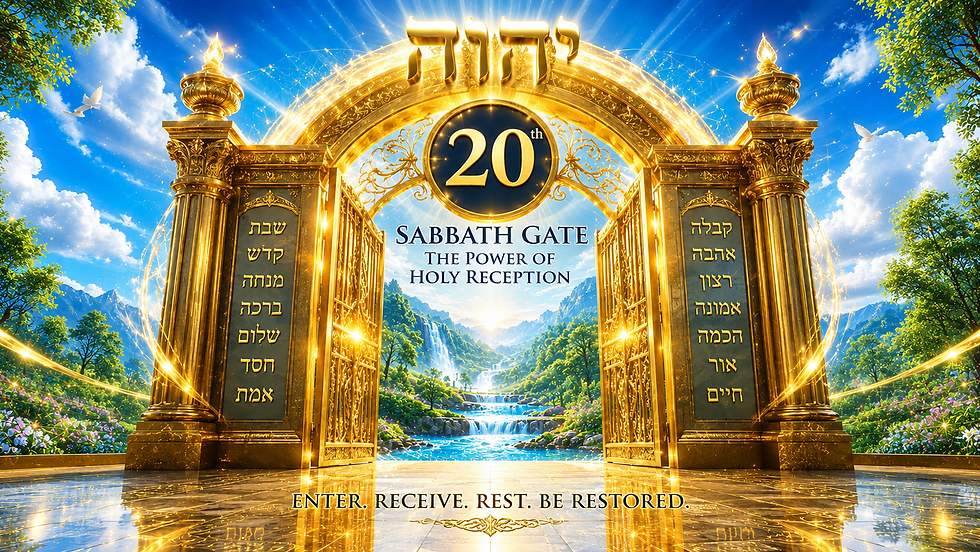
The Hidden Mystery of the 20th Sabbath Gate is about the Power of Holy Reception. As we enter this gate, we again begin our discovery of learning to understand the Sabbath Day.
In our last two Sabbath Gates, we saw that Elohim (God) sanctified the seventh day. This means He separated the seventh day from other days by making it holy and calling it the Sabbath and His own.
We also learned that Yahweh blessed the Sabbath. We discovered that Yahweh placed remarkable treasures within the seventh-day Sabbath. He sanctified it. He blessed it. He endowed it with favor. He bestowed benefits. He intended His people to prosper through it, enrich them, and confer His divine favor upon the sacred appointment He established from the beginning.
Through these discoveries, we are beginning to understand the purpose of the Sabbath in a much deeper way. The Sabbath is much more than a day off. It is Yahweh’s weekly appointment with His people.
Each Sabbath invites us to step away from the noise of the world and return to the rhythm established by our Creator. It is a beautiful gift from Yahweh.
Understanding this is incredible when you look at it, because Yahweh has literally given us the gift of time.
“And he said unto them, The sabbath was made for man, and not man for the sabbath.” — Mark 2:27 (KJV)
This saying of Yahshua (Jesus) is one of the clearest windows into the heart of Yahweh’s law. It can be understood on several levels—historical, theological, and mystical—and each level deepens the one before it.
The historical meaning
Yahshua (Jesus) spoke these words after His disciples plucked grain on the Sabbath because they were hungry. Religious leaders accused them of breaking the Sabbath law.
Yahshua (Jesus) answered:
“The sabbath was made for man, and not man for the sabbath.”
His point was that Yahweh created the Sabbath as a gift, not as a burden. The commandment was intended to preserve life, restore people, and draw them closer to Yahweh—not to enslave them to its legalism or the letter of the law.
The law exists to serve Yahweh’s purposes for us. The fulfillment of the law involves more than simply doing or not doing outward actions.
In Colossians 2:8, one of the most profound words Paul uses is rudiments, and it carries more depth than the English word “rudiments” suggests.
The verse reads:
“Beware lest any man spoil you through philosophy and vain deceit, after the tradition of men, after the rudiments of the world, and not after Christ.” (Colossians 2:8, KJV)
Let’s peel back its layers.
We paraphrase this verse by saying:
“Don’t let anyone trap you into following human ideas, religious traditions, or elementary spiritual teachings that stop your growth. They are only the introduction.
Keep following the anointing, because that is where the real life of Yahweh is found.”
In Hebrew, the word “rudiment” is the Greek word “stoicheion”. The Greek word stoicheion comes from a root meaning “to stand in a row” or “to be arranged in order.”
“Don’t mistake the introduction for the destination.”
That’s essentially what the term “rudiments/stoicheia” means in this context.
Think about how we learn to read. We begin with the alphabet: A, B, C...
Those letters are indispensable. Without them, you can never read. But once you’re reading schoolbooks, Bibles, or any book we enjoy, you don’t sit around admiring the letter “A.” The letters have fulfilled their purpose by leading you into new meaning.
The introduction is essential, but it was never intended to become the destination.
This is the same when learning about the Sabbath.
As we enter into the Hidden Mystery of the 20th Sabbath Gate, we learn that the purpose of the Sabbath being made for us goes much deeper.
The deeper Hebrew perspective:
We know that the word Sabbath (Shabbat) comes from the Hebrew root Shabat, which means to cease, rest, stop, or return to stillness.
Notice that nowhere in this meaning do we see the meaning of simply taking “a day off.”
The Sabbath means ceasing from ordinary striving. Therefore, the Sabbath becomes a symbol of returning to one’s true center or true self, the way Yahweh meant us to be.
The Hidden Teaching:
The word “man” represents the soul journeying through the world. The “Sabbath” represents the soul in a state of divine harmony.
Read symbolically, in Mark 2:27, Yahshua (Jesus) is saying:
Rest exists to restore your soul—not to imprison it.
Many people become servants of religious philosophies, forms, traditions, and rituals.
Yahshua (Jesus) reverses that by explaining that the form exists for the awakening of the spirit.
Yahshua (Jesus) is saying that the outward practice or command exists to help change the inside of a person.
Or:
Your outward action is meant to awaken your inward person.
Or:
The form (what you do) is meant to produce your inner transformation.
Therefore, you must cause yourself to understand that the Sabbath is not just for your outward obedience.
When the form no longer serves love, mercy, justice, and communion with God, it has lost its purpose.
The law and the spirit
This reflects a recurring biblical pattern:
The temple exists to reveal God’s presence.
Sacrifices exist to teach reconciliation.
The priesthood exists to serve the people.
The Sabbath exists to restore us.
None of these are ends in themselves. They are signposts pointing toward communion with Yahweh.
The hidden symbolism
There is another layer that we need to notice. The creation account culminates on the seventh day, when God (Elohim) “rests.”
God (Elohim) does not rest because He is tired. Rather, His rest signifies completion, wholeness, and perfect order.
Spiritually, entering the Sabbath means entering that divine completeness.
It is an invitation to cease striving outside and enter Yahweh’s completion, wholeness, and perfect order. On this day we get to abide in the finished work and experience Yahweh’s good.
An inner Sabbath
The wisdom of the Sabbath, beyond its rudiments, means understanding the Sabbath as an inner reality.
You may be physically active while inwardly resting in Yahweh. You may outwardly keep every rule while inwardly remaining restless.
The deeper Sabbath is a condition of the heart.
It is trusting Yahweh enough to stop trying to secure your worth through endless labor, anxiety, rituals, or religious performance.
The hidden lesson
There is a sacred lesson to the Sabbath Day, and it may be expressed like this: Yahweh never intended His gifts to become chains.
Every divine command has a life-giving purpose. When your practice of Yahweh’s laws leads to compassion, healing, humility, and communion with Yahweh, it fulfills its purpose. When it becomes a source of pride, fear, or oppression, its meaning has been obscured.
In that light, the words “the purpose of the Sabbath being made for us” reveal a principle that reaches into every aspect of spiritual life:
The forms or actions taught about the Sabbath are meant to awaken life, not replace it. The law is fulfilled when it serves love, because love reflects the very character of God Yahweh.
The “hidden Sabbath” is therefore more than a calendar observance. It is the soul’s return to its Creator—a continual invitation to cease striving, receive grace, and live from the peace that flows from abiding in God.
The Sabbath is a gift designed to renew both our minds and our spirits. It is the time Yahweh has ordained, which allows us to stop, gather, remember, worship, study, reflect, and restore ourselves.
This leads us to our first question today.
What good is a gift that is never received?
And another question naturally follows from this one.
How do we receive the gifts Yahweh has already prepared?
The answer begins with the 20th Hebrew letter, Kaph (כ).
Kaph literally means the palm of the hand—an open, cupped hand prepared to receive, hold, and extend what has been given. Unlike a closed hand that grasps or withholds, the open palm is a vessel. It is ready to receive.
This introduces a profound principle that may be called holy reception.
Holy reception is the prepared posture of receiving what Yahweh has already sanctified, established, blessed, and chosen to give.
Before anything can be received, however, it must first be made holy.
For this reason, we must first understand sanctification.
Holy Reception Begins with Sanctification
What good is a gift that is never received?
That question brings us to the heart of the 20th Gate.
Throughout the previous Gate, we discovered that Yahweh placed remarkable blessings within the seventh-day Sabbath. We learned that He blessed it, endowed it with favor, bestowed benefits, intended His people to prosper through it, enrich them, and confer His divine favor upon the sacred appointment He established from the beginning.
Yet discovering that those blessings exist is only part of the journey.
The next question is just as important:
Understanding how to receive the blessings?

We say the answer begins with the 20th Hebrew letter, Kaph (כ), because Kaph literally means the palm of the hand—an open, cupped hand prepared to receive, hold, and extend what has been given.
Unlike a closed hand that grasps or withholds, the open palm is ready to receive.
This is the picture of holy reception.
Holy reception is the prepared posture of receiving what Yahweh has already sanctified, established, blessed, and chosen to give.
Before anything can be received, it must first be purified (cleansed) and made holy.
Genesis tells us that Elohim (God) sanctified the seventh day. Exodus reveals that Yahweh sanctifies His people. These are not two unrelated ideas.
Yet, together, they reveal a beautiful pattern hidden within the Scriptures.
Yahweh not only sanctified a day and made it holy.
He also sanctified a people and made them holy.
He sanctified both.
The Holy One sanctified a holy people to meet with Him in a holy appointed time that He Himself had sanctified.
This is where holy reception begins.
The blessings of the Sabbath are not received just because the seventh day arrives on the calendar. They are received as Yahweh’s people remember Him, meet with Him during the holy appointment, and open their hearts to receive what He offers.
Thus, the Sabbath signifies more than a recurring time. It is a recurring invitation.
Every seventh day, Yahweh opens the appointed time He sanctified.
Every seventh day, His people are invited to enter.
Every seventh day, the open hand of Kaph reminds us that what Yahweh has prepared must also be received.
What Does It Mean to Be Made Holy?
Before we can understand holy reception, we must first understand what it means to be made holy.
The Hebrew word translated “sanctified” is qadash (Strong’s H6942). It means to make holy, to consecrate, to dedicate, to set apart for a sacred purpose, or to regard as holy. In Genesis 2:3, Elohim (God) did more than acknowledge the seventh day. He intentionally separated it from the other six days and appointed it for a sacred purpose.
The English word holy derives from Old English hālig, meaning whole, sound, uninjured, inviolate, sacred, and set apart. Every one of these words helps us understand the biblical meaning of holiness.

To be whole is to be complete, with nothing lacking and nothing missing. It is the opposite of being divided or fragmented.
To be sound is to be healthy, stable, and restored. Something that is sound has been made firm again.
To be uninjured is to be healed. It describes something no longer broken, wounded, or damaged.
To be inviolate is to remain uncorrupted, undefiled, and preserved from violation or profanation.
To be sacred is to belong to Yahweh, devoted entirely to His purpose.
And to be set apart is to be separated from ordinary use because Yahweh has claimed it as His own.
When these meanings are brought together, a remarkable picture emerges.
To be made holy is to be made whole. It is to be restored, healed, preserved, set apart, and devoted to Yahweh’s purpose because one now belongs to Him.
This is exactly what happened in Genesis.
The seventh day became holy because Elohim (God) sanctified it. He separated it from the other six days, devoted it to Himself, and distinguished it from ordinary time.
As the Scriptures continue, however, another remarkable truth is revealed.
Yahweh later declares:
“Verily my sabbaths ye shall keep: for it is a sign between me and you throughout your generations; that ye may know that I am Yahweh that doth sanctify you.”— Exodus 31:13 (KJV)
Notice the order carefully.
First, Yahweh commands His people to keep His Sabbaths.
Then He explains why.
The Sabbath is a sign between Yahweh and His people.
A sign is more than a symbol. It is an identifying mark, visible evidence, a token, an indication of something greater than itself. A sign points beyond itself and silently communicates a reality that words alone cannot fully express.
The Sabbath is therefore the visible sign of an invisible work.
Every recurring Sabbath silently proclaims the same truth:
Yahweh is the One who sanctifies His people.
Genesis reveals that Yahweh sanctified the day.
Exodus reveals that Yahweh sanctifies His people.
The Sabbath becomes the covenant sign joining the two together.
The Holy One sanctified a holy people and caused them to remember Him at a certain appointed time weekly. When you keep the Sabbath, you become a sign to the world of Yahweh's existence and your relationship with Yahweh.
Exodus 31:16–17 teaches us how long we are to be this sign.
"Wherefore the children of Israel shall keep the sabbath, to observe the sabbath throughout their generations, for a perpetual covenant." "It is a sign between me and the children of Israel for ever:..."
Yahweh describes the Sabbath as "a perpetual covenant" and then says it is "a sign... for ever."
That naturally leads us to another question.
How long is forever?
In ordinary language, forever means without end, continually, always, or lasting throughout all time. It describes something that does not expire because time keeps moving. Every tomorrow becomes another today, and forever continues with it.
When Yahweh says that the Sabbath is "a sign... for ever" and that it is to be observed "throughout their generations, for a perpetual covenant," He is describing something intended to continue from generation to generation without reaching an appointed end.
The Sabbath is not presented as a temporary institution or a command for only one season of history. It is presented as an ongoing sign within the covenant relationship between Yahweh and His people.
This also brings us back to another mystery we have already discovered. The seventh day in Genesis is the only day that is never described as ending with the words, "the evening and the morning were the seventh day."
Whether we are reading the creation account or the covenant at Sinai, the Scriptures consistently present the Sabbath as something that continues. It is a recurring appointment that returns again and again, inviting each generation to enter into what Yahweh established from the beginning.
If Yahweh describes the Sabbath as forever, what does that reveal about His purpose for establishing it from the beginning?
It reveals that His purpose is also forever.
The Sabbath is not simply a weekly observance. It is a perpetual covenant, a holy obligation established by Yahweh Himself. Because it is His covenant sign, remembering, honoring, and keeping it are not matters of personal preference. They are part of our covenant relationship with Him.
This is where our purpose begins to meet His purpose.
When we faithfully keep the Sabbath, we willingly place ourselves within the purpose for which Yahweh established it from the beginning. We come before Him to participate in what He is continually accomplishing through it.
Until we recognize that the Sabbath is a holy obligation—a perpetual covenant established forever by Yahweh—we cannot fully grasp its purpose and power. But when we faithfully choose to remember, honor, and keep Yahweh's Sabbath as He commanded, our purpose and His purpose begin to move together. Only then are we prepared to discover the true power of holy reception.
The Two Movements of the Sabbath
As we continue our study, another beautiful pattern becomes apparent. There are two movements taking place every Sabbath.
The first movement belongs entirely to Yahweh.
From the beginning of creation, Yahweh established the Sabbath as a holy appointment in time called the seventh day. He sanctified it. He blessed it. He established it within the rhythm of creation, and every seventh day this appointment continues to arrive exactly when He ordained it. The Sabbath never fails to come because Yahweh is faithful to His own appointed times. Long before we were ever even taught to enter the Sabbath, Yahweh had already embedded His holy purpose, His blessing, and His invitation into that sacred occasion.
Therefore, the second movement belongs to us.
Yahweh’s people are called to respond to what He has already established. He commands us to remember the Sabbath, keep the Sabbath, enter the Sabbath, and assemble before Him.
Holy reception is never passive. It is our response to Yahweh’s invitation.
Think of it this way.
An appointment may be scheduled, but it is only fulfilled when both parties arrive.
Yahweh never misses the appointment. He is always present. The question is whether you will come prepared to meet with Him.
What does it mean to come prepared?
It means we are intentionally presenting ourselves before Yahweh with the desire to become what He is making us to be.
We are allowing Him to gather what has become scattered within us.
We are seeking to become whole where we have been fragmented,
Sound where we have become unstable,
Healed where we have been wounded,
Preserved where we have been corrupted,
Set apart because we belong to Him.
We do not present ourselves as people who have already arrived.
We present ourselves humbly as people who are allowing Yahweh to continue His sanctifying work within us.
Therefore, becoming holy is a journey rather than a single moment. Every Sabbath becomes another opportunity to enter the Sabbath Yahweh established, to receive what He has prepared, and to continue becoming what He is calling us to be.
Are you beginning to see why the Sabbath is therefore more than a recurring day?
This recurring invitation is an appointment Yahweh always keeps. Why?
In Exodus 31:13, Yahweh answers this question. “That ye may know that I am Yahweh that doth sanctify you.”
Our response is to enter it.
Becoming What Yahweh Is Making
Becoming holy is a journey that we must choose to take. It is not forced nor coerced. However, like any journey that you take. there is always a destination.
Therefore, our next question arises:
What is Yahweh making us into?
The answer is holiness. What does it mean to be made holy, and is holiness what you think?
One word associated with holiness is character.
Character is more than outward behavior. It is the defining quality that distinguishes one person from another. It is the imprint left upon the heart and revealed through one’s thoughts, words, choices, and actions. Character is formed within before it is seen without.
The English word holy also means becoming whole.
To become whole is to become complete, with the scattered pieces of our lives being gathered together again. The word “whole” also means becoming sound. Something that is sound is healthy, stable, restored, and fit for the purpose for which it was created.
Holy is also health, happiness, well-being, and blessing. These are all associated with the condition of wholeness. Together, they paint a beautiful picture of what Yahweh continually accomplishes in the lives of His people.
As we continue presenting ourselves before Yahweh, His sanctifying work gradually shapes us. He restores what has been broken, heals what has been wounded, gathers together what has been scattered, and writes His ways more deeply upon our hearts.
Holiness, therefore, is not just something declared over us. It is something that Yahweh continually forms within us. As His work continues, His character becomes increasingly reflected in our lives, and what He is accomplishing within begins to be seen without.
It is the ongoing work of Yahweh restoring us toward wholeness. As we continue responding to His invitation, He prepares us to receive more fully what He has already placed within the Sabbath Day. Health, peace, joy, blessing, wisdom, restoration, and spiritual maturity are not things we manufacture ourselves; they are part of Yahweh’s continuing work as He makes His people whole.
The more we remember and keep the Sabbath, the more His character is formed within us, and the more we experience the fullness of the life He has prepared for us. The more we respond to His invitation, the more we are prepared to receive.
This is why holy reception is an ongoing journey. Every Sabbath becomes another opportunity to present ourselves before Yahweh, allowing Him to continue the work He began.
But what is that work?
It is the work of transformation. Transformation begins when we understand what Yahweh is restoring us to.
One definition of holy is sacred. Something sacred has been made holy because of its association with the Divine. One definition of Divine is the nature of or proceeding from God Yahweh. Another definition of ‘Divine’ is something addressed to or intended specifically for Yahweh.
To be associated with something means to be joined to, connected to, or brought into a relationship with it. Every Sabbath, we choose to enter that relationship again. When we observe the Sabbath, we join ourselves with Yahweh, connect with His nature, and enter into a relationship with Him through the time He established.
These definitions also describe the Sabbath, as it belongs to Yahweh and has been devoted to His purpose. The Sabbath is sacred because it is Yahweh’s Sabbath. We are also brought into a relationship with Yahweh because He declares that the Sabbath is “a sign between me and you throughout your generations” (Exodus 31:13).
The Sabbath is therefore not an isolated observance. It is a sign of the relationship between Yahweh and His people.
Another meaning associated with holy is godlike. To become godlike means becoming like Yahweh. It means reflecting Yahweh’s character, His thoughts, His choices, His actions, His ways, and His purpose in the way we live.
This understanding reaches all the way back to the beginning of creation.
Before sin entered the world, man (male and female) was created in the image and likeness of Elohim (God).
“And Elohim (God) said, Let us make man in our image, after our likeness…”— Genesis 1:26 (KJV)
We were created whole. Complete. Sound. In harmony with Yahweh. The Sabbath was established within that perfect order before anything had been broken.
As history unfolded, man (male and female) became scattered. Our thinking became divided. Our hearts became wounded. Our ways departed from Yahweh’s ways. Yet the Sabbath remained. Every recurring Sabbath continues to stand within creation as Yahweh’s appointed invitation to return to the wholeness He established from the beginning.
Every Sabbath becomes another opportunity to continue that restoration. It is the time when Yahweh continues to form His own image within us if we willingly present ourselves before Him.
This is the transforming work of holy reception. Therefore, the Sabbath is far more than remembering a day. It is about remembering who we were created to be.
Romans teaches:
“And be not conformed to this world: but be ye transformed by the renewing of your mind...” — Romans 12:2 (KJV)
Transformation begins with the renewing of the mind. We cannot continue thinking according to the world’s patterns and expect to become like Yahweh. Our thoughts must be renewed. Our hearts must be renewed. Our souls must continually be shaped by His Word. As our minds are renewed, our character changes, and we gradually become more like the One who is sanctifying us.
The prophet Isaiah explains why this transformation is necessary:
“For my thoughts are not your thoughts, neither are your ways my ways, saith Yahweh.” — Isaiah 55:8 (KJV)
If Yahweh’s thoughts are not our thoughts, and His ways are not our ways, then becoming holy requires learning to think as He thinks and to walk in His ways rather than our own. The Sabbath is our opportunity to lay aside our own understanding and receive His understanding. It is the continual process of exchanging our thoughts for His thoughts, our ways for His ways, and our character for the character Yahweh desires to form within us.
As this transformation continues, Yahweh gathers together what has become scattered within us. He restores what has been broken. He heals what has been wounded. He strengthens what has become weak. He preserves what belongs to Him. He writes His laws upon our hearts and renews our minds so that His image becomes increasingly reflected in our lives.
Holy also points to:
To become whole is to become complete.
To become sound is to become healthy, stable, and firmly established.
To become restored is to be brought back into the condition Yahweh intended from the beginning.
These qualities lead us into health, happiness, well-being, blessing, and flourishing.
Together, they paint a beautiful picture of what Yahweh continually accomplishes in our lives each time we meet Him during His divine appointment, the Sabbath.
So, holy reception is Yahweh’s recurring appointment of transformation.
The significance of holy reception lies in allowing Yahweh to transform us as we take part in this holy time.
The Open Hand of Kaph
The twentieth Hebrew letter, Kaph (כ), literally means the palm of the hand or the hollow, cupped hand. From ancient times, it has been pictured as an open hand—a hand prepared to receive, to hold, and to give.
This image beautifully summarizes everything we have discovered throughout this Gate.
A closed hand cannot receive.
A closed hand cannot freely give.
A closed hand clings to what it already possesses.
An open hand is different.
It is open because it is available.
It is open because it is willing.
It is open because it trusts.
It is open because it is prepared for Yahweh to place within it what He has already prepared from the foundation of creation.
This is a picture of holy reception.
Holy reception is coming before Yahweh with an open heart, mind, spirit, and life, allowing Him to continue His sanctifying work within us. It is choosing to become teachable, transformable, and available to whatever Yahweh desires to accomplish in us.
Kaph provides the image that brings everything we have learned together. The open hand reminds us that transformation requires openness before Yahweh. Only a life that remains open can continue receiving His instruction, His correction, His wisdom, and His character.
Throughout this Gate we have discovered that Yahweh sanctifies. He blesses. He restores. He heals. He gathers together what has become scattered. He renews the mind. He forms His character within His people. Our part is to remain open before Him so that His work may continue.
Perhaps this is the deeper lesson hidden within Kaph.
Receiving is not the sole function of an open hand. It is the hand that is constantly ready and available for Yahweh. One which remains open to receive His instruction, correction, wisdom, His transformation, and the blessings He puts in His Sabbath.
The Scriptures repeatedly speak of the hand of Yahweh as the hand of blessing, provision, deliverance, and power. His hand is always open to accomplish His purpose.
Now that you understand this Sabbath Gate, the question is:
Will you come before Him with closed hands that cling to your own ways?
Or will we come with the open hand of Kaph, ready to receive His thoughts, His ways, His character, and His transforming work?
Will you come with a heart that mirrors His heart?
The mystery of the 20th Gate is what the open hand makes possible.
Yahweh has already sanctified the Sabbath. He has already blessed it. He has already established it within creation. He has already placed His purpose, His wisdom, His instruction, and His transforming work within the seventh day. None of those things are waiting to be created. They are waiting to be received by us.
For these reasons, Kaph becomes such a powerful picture.
The open hand symbolizes a life that is open before Yahweh. An open mind that is willing to be renewed. An open heart that is willing to be changed. An open spirit that is willing to receive His instruction. An open life that is willing to exchange its own thoughts, ways, and character for His.
Every Sabbath becomes another opportunity to open ourselves before Yahweh. As we remember, keep, enter, assemble, and receive, we willingly participate in the continuing work of sanctification through which Yahweh restores His image within us.
This is the hidden mystery of the 20th Gate.
The greatest power of Kaph is found in the life that is willing to open itself completely before Yahweh.
For only what is open can be continually transformed.
As we continue our journey of restoration and rediscovery, each Sabbath Gate reveals another hidden layer of Yahweh's eternal design. Through the mystery of Kaph, we discover that the greatest blessings of the Sabbath are not earned—they are received.
Yahweh has already sanctified the day, prepared His blessings, and established His holy appointment from the foundation of creation. Our invitation is simply to come before Him with an open heart, an open mind, and an open hand.
Each Sabbath becomes another opportunity to remember, to receive, to be renewed, and to allow Yahweh to continue His transforming work within us. The more we respond to His invitation, the more His character is formed within us, and the more we become the people He created us to be from the very beginning.
May Yahweh richly bless you as you continue walking through each Sabbath Gate, discovering the hidden mysteries of His Word, and allowing His Spirit to restore, renew, and transform your life through His holy appointments.
Shalom and abundant blessings until we meet again at the next Sabbath Gate.
The invitation has never changed.
The appointment still stands.
Yahweh is waiting.
“And many people shall go and say, Come ye, and let us go up to the mountain of Yahweh, to the house of the God of Jacob; and he will teach us of his ways, and we will walk in his paths:” – Isaiah 2:3 KJV
“And many nations shall come, and say, Come, and let us go up to the mountain of Yahweh, and to the house of the God of Jacob; and he will teach us of his ways, and we will walk in his paths” – Micah 4:2 KJV
Continue Your Journey
This teaching is part of the ongoing Sabbath Mysteries Series, a 52-week journey through the hidden mysteries, patterns, and divine appointments established by Yahweh from the foundation of the world.
Each Sabbath serves as another Gate of Understanding, revealing deeper truths that strengthen our covenant relationship with Yahweh and transform how we read, understand, and live the Scriptures.
Continue your journey through the Sabbath Mysteries Series and the Kingdom of Shalom Learning Hub, where you'll discover additional biblical teachings, Hebrew word studies, videos, music, and biblical resources designed to help you grow in wisdom and understanding.
KINGDOM OF SHALOM LEARNING HUB
🌐 Website: www.KingdomofShalom.com
Connect With Us
▶️ YouTube: Kingdom of Shalom
📘 Facebook: Kingdom of Shalom
📸 Instagram: @KingdomofShalom
🎵 TikTok: @KingdomofShalom
🎶 KOS Music
Coming Soon: The Original Timekeepers Book
May this 20th Gate of Holy Reception remind you that Yahweh has already sanctified the Sabbath, already prepared His blessings, and already established His holy appointment. Each Sabbath is another opportunity to come before Him with the open hand of Kaph, ready to receive His instruction, His wisdom, His transformation, and the fullness of what He has prepared from the foundation of creation.
✨ Remember to live with your full spirit,
and don't let anything get in the way.
Peace and blessings,
Shabbat Shalom
The Kingdom of Shalom
#YHWH #KingdomOfShalom #SabbathMysteries #20thSabbathGate #PowerOfHolyReception #HolyReception #Kaph #HebrewLetters #Sabbath #SeventhDaySabbath #RememberTheSabbath #KeepTheSabbath #Shabbat #ShabbatShalom #HolyConvocation #HolyAppointment #Sanctification #Holiness #Transformation #Restoration #Wholeness #RenewYourMind #ImageOfYahweh #CharacterOfYahweh #OpenHand #Receive #ReceiveHisBlessings #BiblicalMysteries #BibleStudy #HebrewRoots #Creation #Genesis #Exodus31 #Yahweh #Yahshua #KingdomLiving #OriginalTimekeepers #RestorationOfAllThings



Comments