
The 25th Sabbath Gate Mystery: Behind the Seven Veils


Entering the 25th Sabbath Gate Part Four
— The Mystery of Seven
We have now arrived at Sabbath Gate 25, and before we step behind the remaining four veils, we must first look at the number of the Gate itself. As we have discovered throughout this journey, the number of each Sabbath Gate often provides a symbolic picture of the understanding we are preparing to enter.
The number 25 is the sum of 20 and 5.
20 — Kaph: The Open Hand
In Sabbath Gate 24, Kaph gave us the imagery of the open hand—the ability and capacity to receive, hold, and possess what is being given. Within 20, we contemplated the imagery of two open hands, fully positioned to receive greater understanding.
That imagery does not disappear when we enter Gate 25. Our hands are still open. We have already received much through the first three veils, but there is still more to uncover. The knowledge we received in Sabbath Gate 24 becomes the foundation upon which the remaining veils can now be opened. We are not returning to the beginning; we are continuing from a place where our capacity to receive has already been enlarged.
Then 25 brings us to 5.
5 — Heh: Behold What Is Being Revealed
Heh is the fifth letter of the Hebrew alphabet. In reconstructions of the ancient Hebrew pictographic tradition, Heh is represented by the image of a person standing with the arms raised. This image has been associated with the ideas of behold, look, and reveal—as though something has appeared before the person, prompting the hands to rise and attention to turn toward what has been revealed.
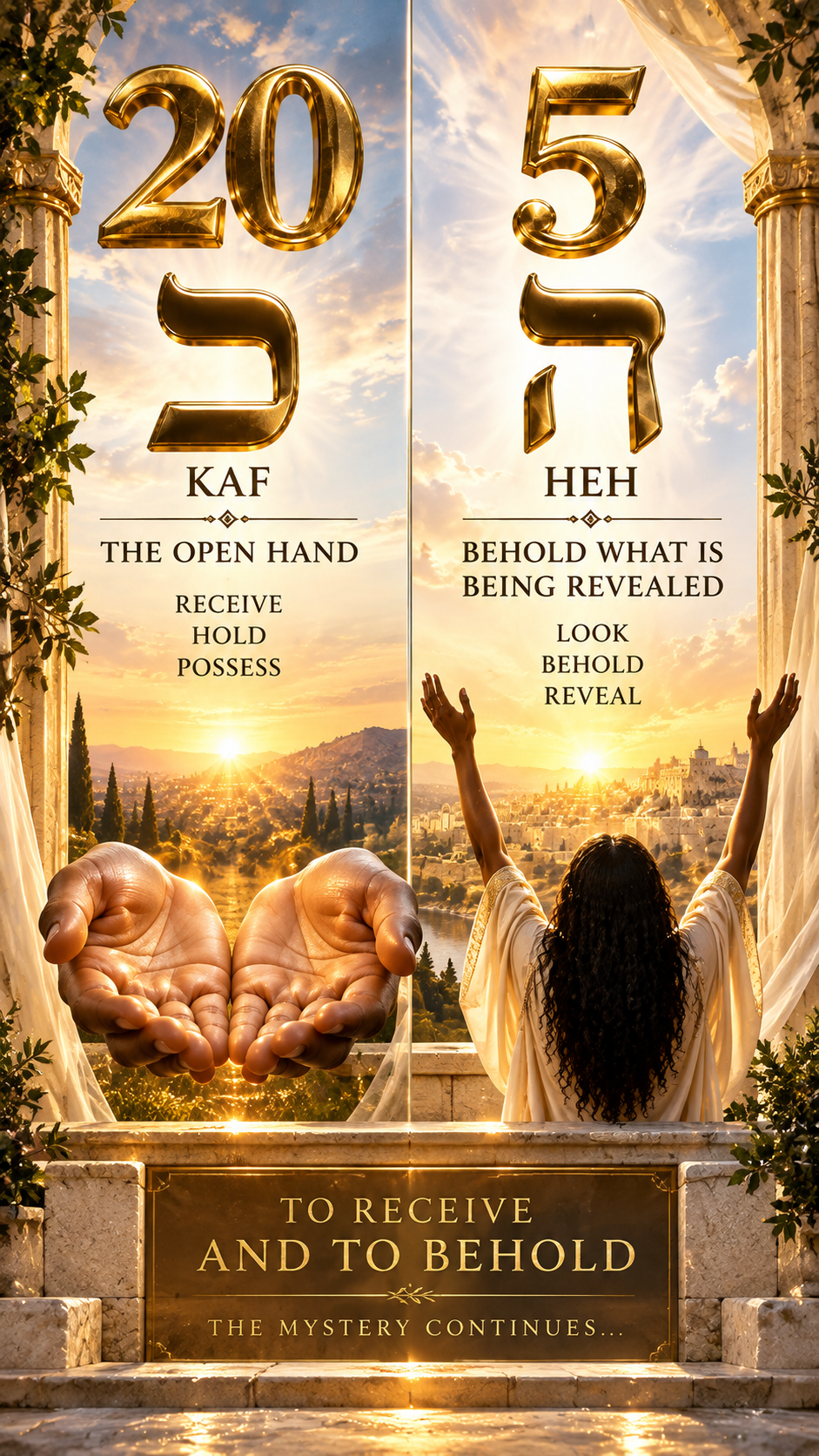
That picture is particularly meaningful for this Sabbath Gate.
Kaph gives us open hands prepared to receive, and Heh gives us the image of a person with those hands opened and raised, beholding what is being revealed. When these two images are brought together within 25, we receive the symbolic picture of someone who is not only prepared to receive but is now being called to look, behold, and recognize what has been uncovered.
There is another reason Heh deserves our attention. Heh appears within the Divine Name Yod-Heh-Wav-Heh, and it appears there twice. Therefore, as we enter a Gate concerned with revelation and the deeper mysteries of Seven, the fifth letter also places before us a letter contained within the Name itself.
But 25 gives us one more striking feature:
2 + 5 = 7
The very number of this Sabbath Gate returns us to Seven.
We entered the Mystery of Seven asking a simple but profound question: Why Seven? And now, after passing through Gates 22, 23, and 24, the number of Gate 25 itself brings us directly back to the mystery we have been pursuing.
Twenty-five, therefore, gives us a powerful symbolic picture for what lies ahead: open hands prepared to receive, raised hands prepared to behold, and a Gate whose own number returns us to Seven.
We are ready to go Behind the Seven Veils.
Where the First Three Veils Took Us
Before we enter the Fourth Veil, we need to remember what has already been uncovered—not to repeat the entire journey, but to understand the foundation upon which we are now standing.
The First Veil — OTH: The Sign
The First Veil caused us to slow down and examine the Hebrew word OTH. We discovered that OTH can mean sign, mark, token, pledge, memorial, evidence, and distinguishing sign, and we followed its use through covenant relationships involving Noah, Abraham, and the Sabbath.
This showed us that a sign does more than exist. A sign points beyond itself. It identifies, remembers, witnesses, distinguishes, or directs our attention toward something greater than what appears before the eye.
And Yahweh calls the Sabbath an OTH.
The Sabbath, therefore, does not simply tell us when to cease from labor. It signifies, bears witness, and points toward something that the people of the covenant are meant to recognize and remember.
The Second Veil — What We See and What We Hear
The Second Veil taught us to use more than the eye.
When we see OTH, we see: Sign. Mark. Token.
But when the English-speaking ear hears OTH, it hears: OATH.
And suddenly, what we had already uncovered about Seven came back into the investigation. Shebaʿ—Seven — belongs to the same Hebrew word-family as shabaʿ—to swear, to take an oath, or to bind oneself by oath.
The sign and the oath began to meet. The oath speaks to the binding promise. The sign speaks to the recognizable witness of that relationship.
And the Sabbath stands within the covenant as an OTH, continually calling the covenant people to remember the promise, the allegiance, and the One with whom the covenant was established.
The Third Veil — Signs Were Present at Creation
Then the Third Veil took us farther back than Sinai, Abraham, or Noah.
It took us to Creation.
Genesis 1:14 revealed OTHOTH—signs, the plural of OTH, within the created order. Those signs were connected to mo'edim—appointed times—along with days and years.
From there, we discovered that the principle of recognizing sacred appointment was built into Creation from the beginning. Later, Leviticus revealed Yahweh's appointed times, and Seven appeared repeatedly within their structure—the seventh day, seven-day sacred periods, seven complete Sabbaths, the seventh year, seven Sabbaths of years, and seven times Seven.
By the end of the Third Veil, we could no longer treat Seven as though it were simply one number attached to one Sabbath commandment.
We discovered that Seven is woven into the architecture of sacred time.
But that discovery brought us back to the question that began this entire journey.
We now know much more about where Seven appears. We have seen Seven within the oath. Within covenant. Within the sign. Within appointed sacred time. Within days. Within years. Within sevenfold patterns that continually return.
But knowing where Seven appears still leaves us with the deeper question: What is Seven? An ancient description of Shebaʿ—Seven that begins to answer that question:
“The Sacred Full One.” And this is where we left the Fourth Veil waiting.
Now, in The 25th Sabbath Gate Mystery: Behind the Seven Veils, it is time to open it.
The Fourth Veil — Seven: “The Sacred Full One”
The Third Veil showed us that Seven is woven into the architecture of sacred time. We found Seven within the Sabbath, the appointed times, sacred days, sacred years, and even within the seven-times-seven patterns established by Yahweh. But seeing where Seven appears still does not completely answer the question that began this journey: Why Seven?
To understand that, we must return to the Hebrew word we have been studying: Shebaʿ — Seven. In some older lexical treatments, shebaʿ is described with a striking expression: “The Sacred Full One.” Those words deserve our attention because each one reveals something about the nature of Seven: Sacred. Full. One. And when the three are brought together, they take us beyond the familiar statement that “Seven means completion.”
SACRED — Set Apart
Something that is sacred is distinguished from what is common and set apart for a holy purpose. In biblical Hebrew, the word family associated with holiness and what is set apart is qodesh. It conveys the idea of something holy, sacred, consecrated, or set apart from the ordinary.
This immediately takes us back to the first sevenfold pattern in Scripture. There are seven days in the work of the Creation process, and when Genesis reaches the seventh day, something happens that did not happen to the previous six:
“And Elohim (God) blessed the seventh day, and sanctified it: because that in it he had rested from all his work which Elohim (God) created and made.” — Genesis 2:3
The seventh day is sanctified. It is distinguished and set apart. Within the Creation order, the seventh position is treated differently from the six positions that preceded it. Elohim (God) blesses and sanctifies it, setting it apart from ordinary time. So when we encounter the expression “The Sacred Full One,” the first word already points us toward something we have seen from the beginning: Seven occupies a set-apart place within the order established by Elohim (God).
But Sacred gives us only the first part of the expression. The second word takes us deeper.
FULL — Nothing Is Missing

What does it mean for something to be full? Fullness means that something has reached its intended measure. What belongs within it has been brought into place. Nothing necessary to the whole is missing.
This is important because fullness is not the same as simply stopping. Something can stop because it was interrupted or abandoned. Something can stop and still remain unfinished or unfilled. But when something reaches fullness, it has reached its intended measure; it is finished, and there is nothing else that can go into it.
Now let’s return to Creation. The work unfolds through the first six days, and then Genesis tells us:
“Thus the heavens and the earth were finished, and all the host of them.”— Genesis 2:1
Notice the word: finished. Creation has not been abandoned or interrupted. What Elohim (God) was establishing has reached the point Scripture calls finished. Then we read:
“And on the seventh day Elohim (God) ended his work which he had made; and he rested on the seventh day from all his work which he had made.” — Genesis 2:2
Here we begin to see the relationship between fullness, completion, and rest. The work reaches its appointed end; the work ceases, and rest appears. In this sense, the movement is fullness → completion → rest.
This gives the seventh day of rest another dimension. Go back to the beginning of the Creation account. Genesis 1:2 describes the earth as without form and void. The Hebrew word bohu, translated as void. The word “void” means empty, without contents, wide, hollow, or desolate.
When Scripture says the earth was void, it means that Creation began in emptiness. From that condition, Elohim (God) begins to order, distinguish, form, fill, and establish. What was empty was filled. What was unformed becomes ordered. What was being established is brought to completion. It becomes Seven.
This movement from emptiness toward fullness gives us another way to contemplate the sevenfold Creation pattern. Seven stands at the boundary where the work being established has reached its appointed fullness and the work can cease.
This raises another question: If fullness is reached when the whole is complete, what tells us that fullness has been reached?
Seven itself becomes a sign of fullness. When Seven appears, it is a sign that something has reached the point associated with completion. This means that whatever was being formed, filled, or established has arrived at its fullness. Seven, therefore, does more than give us a number to count. Seven becomes a sign that points toward fullness, completion, and wholeness.
And this brings something we uncovered beneath the earlier veils back into view. We learned that a sign points beyond itself toward something we are meant to recognize. This means that Seven continually directs our attention beyond the number itself and causes us to ask: What is becoming fulfilled? What is being brought into fullness? What is becoming whole?
This is why the Sabbath's association with Seven becomes so important. The Sabbath itself is a sign, and its position within Seven directs our attention toward fulfillment. Every time the Sabbath returns, and we keep it, we are not simply arriving at the end of another seven-day cycle. We are participating in something that points beyond the passing of time. Our keeping of the Sabbath is connected to fulfilling what has been established, and we need to ask what is being fulfilled through our actions, our obedience, and our return to this sacred appointment.
That question takes us deeper into the expression “The Sacred Full One.” Seven is not simply the number at which something ends. Seven is a sign that something is being brought into fullness, completion, and wholeness. And the Sabbath continually calls us back to recognize and participate in that fulfillment.
Now the word Full in “The Sacred Full One” begins to carry greater weight. Seven is a measure that has become full. But this raises another question: Why call it One?
ONE — The Whole
One speaks of unity, wholeness, singleness, and that which exists as an undivided whole. This does not mean that a whole cannot contain parts. A body contains many members and is still one body. In the same way, a sevenfold structure contains distinguishable positions—one, two, three, four, five, six, seven. Each can be counted, distinguished, and recognized in its own position, yet together they constitute one complete Seven.
This is the important distinction. Seven is not just a collection of seven disconnected things. Together, the parts constitute one sevenfold whole. All that belongs to the measure has been gathered into a single complete unit.
This is where Full and One meet. The One is not one isolated part of the Seven; the One is the whole Seven brought together as one complete measure. Another way of looking at this is that all seven parts are joined together as one complete unit. They are together in oneness. Nothing belonging to that Seven is missing. All seven positions are present, and because the entire measure is present, it is full. Because all its parts belong together as one completed whole, it is One.
So, when we speak of “The Sacred Full One,” Full and One are not disconnected ideas. The One is full because nothing belonging to the whole is missing, and the full Seven is One because all that belongs to the Seven has been gathered into a complete, undivided whole.
This gives us another way to understand Seven: Seven is the many brought into fullness as One.
But there is something else within Seven that deepens the mystery of One. Seven is a prime number. It can be divided evenly only by One and itself. Spiritually, those words open another dimension of what we have been uncovering: Seven returns to the One and to itself.
This becomes even more striking when we return to the Creation pattern. On the sixth day, Elohim says, “Let us make man in our image, after our likeness” (Genesis 1:26). Then Genesis tells us, “So Elohim created man in his own image, in the image of Elohim created he him; male and female created he them” (Genesis 1:27). Man is therefore created as image. The image comes from the One whose image it bears. Something of the identity of the One is reflected in the image. The image of the One is itself.
And what follows the creation of the image? Seven—the Sabbath.
This gives us another way of seeing the movement from Six into Seven. On Six, the image of Elohim (God) appears in the manifest as man (male and female). On Seven, this male and female image of Elohim (God) enters the Sabbath. And because Seven returns mathematically to One and itself, spiritually Seven can be contemplated as the return of the image (man) to the One and, through that return, to its true self.
The two are connected because the true self of the image cannot be separated from the One whose image it bears. To return to the One is to return to the Source of the image. And in returning to the Source of the image, the image encounters what it truly is.
Seen this way, the Sabbath reveals something deeper than the cessation of work. For six days, there is making, forming, ordering, filling, cultivating, and doing. But then Seven brings the movement of work into rest. The image ceases from its works and returns to the One. Sabbath becomes a sacred return from doing to being, from what we have made to what we were made to be, from the works of our hands to the image from which our true identity comes.
This gives extraordinary depth to the words “One and itself.” Seven returns us to the One. But in our return to the One, we, the image, return to our true selves. The self we encounter there is not the self we have fashioned through labor, accomplishment, possession, title, or outward identity. It is a deeper self—the image of Elohim (God) that existed before any work could define it.
Perhaps this is the greatest mystery of Sabbath. The Sabbath calls the image—man—home. It returns the image to the One so that the image may remember itself in the One whose likeness it bears. And suddenly the final word in “The Sacred Full One” becomes even more profound. One is not only the wholeness of the completed Seven. It also points toward the return contained within Seven: the many gathered again into wholeness, the image returning to its Source, our self returning to the One—and there discovering itself again.
Seven, then, is not only fullness and completion. Seven is also return. And the Sabbath, as the sacred Seven, becomes the appointed place of that return: back to the One, back to the image, back to the true self.
SACRED — FULL — ONE
Now we can bring the three words together.
Sacred tells us that Seven is set apart and distinguished. Full tells us that the complete measure is present, with nothing belonging to that measure missing. And One tells us that everything belonging to that full measure has been gathered together as one complete, undivided whole.
This is where the expression “The Sacred Full One” becomes much clearer. The Full and the One are not describing two unrelated conditions. The One is full because nothing belonging to the whole is missing, and the full Seven is One because all that belongs to Seven is present within one complete measure.
In other words, the One is the full Seven, and the full Seven is one whole.
This takes us considerably deeper than the familiar statement “Seven means completion.” Completion is part of the mystery, but now we can see what that completion looks like. Seven represents a sacred measure in which everything belonging to the measure is present, nothing is missing, and all of its parts together constitute one whole.
This is The Sacred Full One. This is The Seven
And within the Sabbath, this wholeness opens another spiritual mystery we have already begun to uncover: return. The image returns to the One, the many are gathered toward wholeness, and what has been scattered through our labor and doing is called back toward the fullness of what we were created to be.
So Seven does not point only toward an ending. It points toward fullness, wholeness, and return—the sacred measure brought to completion and gathered as One.
And this gives us a deeper way to understand what the Sabbath represents. If Seven points toward fullness, wholeness, and return, then the Sabbath becomes the sacred appointed time in which we are called back toward those same things: becoming full, becoming whole, and returning to the Divine image in which we were created.
For six days, we move through the world of work, labor, producing, building, and doing. But the Seventh calls us back. It calls us from what we have been doing toward who we were created to be. It becomes an appointed return to the One, where what has become scattered into separate parts can be gathered, what has become depleted within us can be filled, and we, as the original image, can remember our Source.
In this sense, the Sabbath is not only the completion of a sevenfold measure of time. It is our sacred appointment of return—to fullness, to wholeness, and to the Divine image: Yahweh.
Seven, Oath, and Covenant
Now that we understand Seven as The Sacred Full One, we can better understand the importance of something we uncovered earlier in our investigation: Seven → Oath → Covenant. An oath is a binding promise or vow, while covenant establishes the sacred relationship within which that promise is lived and kept. But the Sacred Full One adds something important to this relationship: what has been promised must become fulfilled. The oath cannot remain only words that were spoken; what was promised must be lived, kept, and brought into fulfillment.
This gives us a deeper way to understand the relationship between Seven and the Sabbath. The Sabbath, being associated with Seven, continually brings the oath and covenant back before us. When we keep the Sabbath, it becomes a sign that we are keeping our oath, remaining aligned with the covenant, and returning to the One with whom the covenant was made.
Our actions become part of the fulfillment of what was promised in Exodus 19:8, Exodus 24:3, and Exodus 24:7:
“All that Yahweh hath spoken we will do.”
And this brings the Sabbath directly into what we have discovered about The Sacred Full One. The Sabbath is our sacred appointment of return: a return toward fullness, a return toward wholeness, a return toward faithfulness, and a return toward the Divine image—Yahweh. That which has become void: empty, desolate, depleted and with content is filled and becomes full. And through our return to the One, we are continually being called back toward the wholeness and Divine order for which we were created.
Therefore, the Sabbath, as Seven, points toward fulfillment that is still being lived. Through the Sabbath, the sign continues, the oath is remembered and kept, the covenant remains active, and we continue returning to the Holy "One".
“Hear, O Israel: Yahweh our God is one Yahweh:” — Deuteronomy 6:4
In this way, Seven, oath, covenant, faithfulness, fulfillment, fullness, wholeness, and return all meet within the Sabbath.
But another distinction remains hidden within this mystery.
Throughout this investigation, we have been studying Seven. Yet when Scripture identifies the Sabbath within the Creation pattern, it does not simply say Seven.
It says: THE SEVENTH.
That small difference may reveal considerably more than we realize.
What is the difference between Seven, sevened, and Seventh? And what happens when Seven becomes the Seventh?
The Fifth Veil begins there.
.
The Fifth Veil — Seven and the Seventh
The Fourth Veil brought us into a deeper understanding of Seven as “The Sacred Full One.” We discovered that "Full" means that everything necessary to make the whole complete is present—nothing is missing. One means that everything belonging to that completed measure has been brought together as one whole. Therefore, the Sacred Full One presents Seven as a complete and fulfilled whole, with everything in its proper place and brought into divine order.
But there is one word within “The Sacred Full One” that requires us to take this investigation deeper:
SACRED.
Once we identify Seven as sacred, we are invited to look beyond what we know physically about the number Seven. Something sacred is considered holy, consecrated, and set apart. This moves our investigation beyond understanding Seven only as a physical number that can be counted, divided, or mathematically examined, and causes us to ask what Seven represents on a deeper spiritual level.
To do this, we must move beyond the physical. This brings us to another kind of investigation:
METAPHYSICAL — Beyond the Physical
The word metaphysical means looking beyond what is physical. It looks beyond the material world and what we can physically see and observe. Metaphysical means examining what lies beyond the outward physical form into the spiritual meaning, the inner meaning, and the deeper reality.
To understand Seven from this perspective, we turn to the Metaphysical Bible Dictionary, which helps us examine the spiritual ideas, principles, and inner meanings represented through biblical words and symbols.
Under the word Seven, the Metaphysical Bible Dictionary states:

“The number seven represents fullness in the world of phenomena; seven refers to the divine law of perfection for the divine-natural man.”
This definition immediately brings us back to something we have already uncovered:
FULLNESS.
The word phenomena refers to what appears, occurs, or is experienced within our world.
Therefore, when the metaphysical definition says that Seven represents “fullness in the world of phenomena,” it presents Seven as a picture of fullness expressed within our manifested existence.
But the metaphysical understanding of Seven takes us even deeper. Metaphysically, Seven is understood as bringing together the spiritual and the physical, or heaven and earth, within one complete experience. Three represents the spiritual, heavenly, or Divine aspect, while four represents the physical, earthly, or material aspect.
When the two are brought together: 3 + 4 = 7
The spiritual and the physical meet within Seven.
The heavenly and the earthly are brought together within the whole.
This gives us another way to understand The Sacred Full One. Seven becomes a symbolic joining of the spiritual and physical aspects of existence, bringing what belongs to heaven and what belongs to earth into a complete experience of wholeness and oneness.
This principle brings to mind the words:
“Thy kingdom come. Thy will be done in earth, as it is in heaven.”— Matthew 6:10
There is a heavenly order, and there is an earthly experience in which that order is to become manifest, and seven is part of it. The spiritual is not intended to remain disconnected from the physical. What belongs to the Divine order is to be expressed within the manifested world.
Now the meaning of fullness becomes even greater. Seven, the Sacred Full One, is not simply about reaching the end of a numerical sequence. It points toward wholeness—the spiritual and physical being brought into divine order, with nothing belonging to this whole missing.
But the Metaphysical Bible Dictionary gives us another important piece of this mystery:
“Seven refers to the divine law of perfection for the divine-natural man.”
When you read this sentence, your next question should be: Who or what is the “divine-natural man”?
Simply put, the divine-natural man is us when our Divine or spiritual nature is expressed through our natural, physical existence, or this body. It describes a state in which our spiritual and physical aspects come together within our human experience, allowing that which is Divine within us to be expressed through our life in the natural world. This is what the Sabbath does. It brings us back to our divine-natural selves.
Now this brings us back to Seven, which brings us into:
DIVINE LAW AND PERFECTION.
If Seven metaphysically refers to the divine law and perfection, then Seven points toward an order through which fullness, wholeness, and perfection are established. The whole Seven becomes important because the perfection associated with Seven requires the full Seven. Six does not complete Seven. Fullness is reached when everything belonging to the Seven is present, and the whole is complete. It is considered perfect.
This gives greater meaning to the words of Yahshua:
“Be ye therefore perfect, even as your Father which is in heaven is perfect.”— Matthew 5:48
What does it mean to become perfect?
It means to become whole and complete, brought into the oneness of the Divine Order for which we were created. Understanding perfection, therefore, brings us back to the very things we have been uncovering throughout The Sacred Full One: fullness, wholeness, oneness, Divine order, and the Divine image.
We began by looking at Seven as a number. But once Seven became sacred, our investigation required us to look beyond the physical number and examine what Seven represents spiritually. Now its metaphysical meaning has taken us deeper. Seven points toward spiritual fullness, Divine law, perfection, wholeness, and Divine order, bringing the spiritual and physical into one complete experience.
We have already discovered what Seven as The Sacred Full One means. Now we understand another dimension of what that fullness represents.
SEVEN AND SEVENTH
Let’s take a deep dive to look more closely at the word itself. The number Seven first gives us a quantity. Quantity tells us how much or how many of something there is. It describes an amount, number, or total, and it also refers to something that can be counted or measured. Therefore, within the mystery we are uncovering, Seven gives us more than the number of things being counted. It gives us a measure or a capacity to compare something with the standard. A standard is an established rule or model for judging quality, value, or one’s behavior.
Now this gives us another way to understand Seven. Seven provides a measure, but that measure points us toward a standard. And from everything we have uncovered about The Sacred Full One, the standard associated with Seven is one of fullness, wholeness, Divine order, and perfection. Seven therefore becomes part of the standard by which we can recognize whether something has reached the fullness for which it was established.
This is where the Sabbath becomes important. The Sabbath is associated with Seven, but Yahweh also specifically established, blessed, sanctified, and commanded His people to keep it. Therefore, the Sabbath gives us more than a recurring day within a sequence of Seven. The Sabbath becomes part of the Divine standard—an appointed measure through which our actions can be brought into alignment with what Yahweh established.
Seven gives us the measure. Scripture repeatedly gives us something even more specific. It calls the Sabbath:
THE SEVENTH.
Seventh does not tell us how many. It tells us which position something occupies within the order of Seven. And because Seven has now revealed itself as more than a quantity—as a measure connected with a Divine standard, the Seventh can no longer be treated as an ordinary position within a simple numerical sequence. In the case of our study, the Sabbath occupies the seventh position.
We now need to investigate what it means to occupy the Seventh position within The Sacred Full One. In order to reveal this mystery, we must discover what is contained within the word Seventh, and what the Seventh reveals about the Divine standard we have been uncovering.
And this is where the word Seventh begins to reveal considerably more than what we see on the surface.
WHAT DOES IT MEAN TO BE SEVENTH?
We commonly understand Seventh as an ordinal position: something that comes after the sixth and occupies the seventh position within a series. But when we look more deeply into the history and meaning of the word, Seventh tells us considerably more about what is happening within the Seven.
The Online Etymology Dictionary defines seventh as:
“next in order after the sixth, last in order of a series of seven; being one of seven equal parts into which a whole is or may be divided.”
The first part of this definition gives us what we already recognize: Seventh is the final position in a Series of Seven. But the second part takes us deeper, introducing something we have been investigating throughout this mystery—the whole. Seventh can also refer to one of the seven parts into which a whole is or may be divided.
This becomes especially important after our investigation of The Sacred Full One. We have already discovered that the full Seven represents a whole in which everything necessary for completeness is present and nothing is missing. Now, as we investigate Seventh, we discover that we can understand this whole through seven parts. Each part belongs to the whole, and each occupies its place within the Seven.
But another layer in our investigation of Seventh is one most people have probably never stopped to consider. As we look more deeply into the language behind "Seven" and "Seventh," we encounter another form. And to gain access to this secret, we have to look beneath the modern form of the word Seventh. Within its earlier history, the word “seventh” was once spelled and written as:
SEVENED — with ED, not TH
Sevened and Seventh are not two related words. Sevened is an older word for the word we now know as Seventh. The form changed from -ed to -th, but the deeper conceptual meaning it carried remains. The definition of "sevened" offers another way to understand what it means for something to be Seventh.
To be sevened means that something that was one whole has been divided, grouped, cut, or constituted into seven distinct parts or units.
You begin with the One, like the Sacred Full One, which is whole. Then that wholeness is sevened or divided into parts. The whole is now understood through seven distinguishable parts. In the biblical Hebrew word family, shabuaʿ gives us the concept of a sevened unit, a collection or cycle consisting of seven.
This makes the language of Seventh much more significant. When we hear "Seventh," we should not think only of a number that comes after Six. The deeper history of the word now brings us into the concept of something having been sevened—the One divided and ordered into Seven.
We have uncovered that Seven can be “sevened.” A period or structure of Seven can be understood as constituted or ordered as a unit of seven. And that matters because if the measure is Seven, fullness requires the whole Seven. If one part of a sevenfold structure is missing, the sevenfold measure has not been reached. Six is not Seven. But when everything belonging to that sevenfold measure is present, we have the full Seven.
But this is only one dimension of what it means to be sevened. There is another one.
Within the ancient biblical language surrounding Seven, to be “sevened” also carries the meaning of becoming bound by a sacred oath or covenant.

Here, Seven moves from division into binding. To be sevened means that a person has given their word and has become bound, fastened, fixed, or secured by what has been declared.
This means the agreement is not casual, temporary, or something entered into with the expectation that it can simply be changed whenever one chooses. To "sevened oneself" establishes an obligation intended to hold, endure, and remain unbroken.
This is why the ancient concept of the covenant evokes the imagery of marriage. The covenant between Yahweh and the Israelites is repeatedly described through the imagery of marriage. Yahweh tells Israel,
“For thy Maker is thine husband; Yahweh of hosts is his name” - Isaiah 54:5,
And He later describes the covenant with the Israelites by saying,
“which my covenant they brake, although I was an husband unto them” - Jeremiah 31:32.
and then
“Turn, O backsliding children, saith Yahweh; for I am married unto you…” - Jeremiah 3:14:
The Israelite's covenant relationship with Yahweh can therefore be understood through the imagery of a people joined and bound to Yahweh as a wife is joined to her husband.
To marry means to join, unite, or bring together. Marriage takes two distinguishable people and joins them through a binding agreement. They unite and become one. They remain distinguishable, yet through an agreement, they enter into a union.
In the same way, the concept of being sevened carries the power of something being joined, bound, pledged, and held together through an agreement.
Now we see something fascinating appears within this same word. To be sevened means something is divided into seven, while also meaning being bound through seven. One meaning takes the One and reveals its distinct parts; the other brings us into joining, agreement, covenant, oath, and union.
Division and Binding exist in harmony within the same mystery of Seven.
This changes how we hear the word Seventh.
When we speak of the Sabbath, we are dealing with the idea of being sevened. We see it as something divided and ordered into seven parts, and also as something bound by oath, covenant, agreement, joining, and union.
To be sevened, then, is not a weak or casual condition. It carries the idea of something cut or divided into seven, established as full, whole, complete, perfect, holy, and set apart. Sevened shows us an oath that binds, a covenant that joins, and an agreement that holds forever. This is the Sabbath.
“Speak thou also unto the children of Israel, saying, Verily my sabbaths ye shall keep: for it is a sign between me and you throughout your generations; that ye may know that I am Yahweh that doth sanctify you.” — Exodus 31:13
Then:
“Wherefore the children of Israel shall keep the sabbath, to observe the sabbath throughout their generations, for a perpetual covenant.” — Exodus 31:16
And:
“It is a sign between me and the children of Israel for ever…”— Exodus 31:17
So you actually have three very powerful phrases together: “throughout your generations” → Exodus 31:13, “a perpetual covenant” → Exodus 31:16, and “a sign…for ever” → Exodus 31:17
What has been entered into is intended to remain, because those involved have become bound by what has been declared.
The Sabbath being Seventh—or sevened— therefore carries the language of something established to remain. The sign continues throughout the generations; the covenant is perpetual, and the relationship is declared to endure forever.
What has been entered into is intended to remain because those involved have become bound by what has been declared.
And with this understanding of Seventh and sevened, we are ready to return to the language of Genesis and look again at a familiar expression we have been reading throughout this entire investigation.
Genesis does not simply give us: SEVEN.
Neither does it stop with: SEVENTH.
The Scripture says: SEVENTH DAY.
And suddenly, an entirely new question appears.
What does it mean for DAY to be SEVENED?
What if the mystery of the Sabbath has been sitting within those two words all along?
Now that we understand considerably more about Seven. Having pushed back the veil to reveal the concept of Seventh as a position, while simultaneously carrying the ancient language “sevened,” meaning something being divided according to Seven, and also a binding, oath, covenant, joining, and union, we now begin to look at “SEVENTH DAY.”
Before we answer what it means for DAY to be sevened, we must answer one question we have not yet asked: WHAT IS DAY?
That question will open the Sixth Veil during the 26th Sabbath Gate Mystery.
And when we return for the 26th Sabbath Gate Mystery, we will step through it.
Because the mystery before us is no longer just: Why Seven?
It has become: What is the Sevened Day, and why was it changed to the Seventh Day?
Continue Your Journey
This teaching is part of the ongoing Sabbath Mysteries Series, a 52-week journey through the hidden mysteries, patterns, and Divine appointments established by Yahweh within the Sabbath.
Each Gate opens another layer of understanding, revealing that the Sabbath is far more than a day of rest. It is an appointed time of learning, revelation, remembrance, restoration, and return—a sacred space in time through which Yahweh continually calls us back to Himself.
As we continue through these Gates, allow each Sabbath to take you deeper. Continue reading. Continue searching. Continue asking questions. Continue seeking the wisdom hidden beneath the surface of the words.
For there is always more to discover.
“And many people shall go and say, Come ye, and let us go up to the mountain of Yahweh, to the house of the God of Jacob; and he will teach us of his ways, and we will walk in his paths...” — Isaiah 2:3
“And many nations shall come, and say, Come, and let us go up to the mountain of Yahweh, and to the house of the God of Jacob; and he will teach us of his ways, and we will walk in his paths...” — Micah 4:2
The journey continues.
But Scripture gives us two words: SEVENTH DAY.
So when we meet again at the 26th Sabbath Gate, we will begin with the question that now stands before us:
WHAT IS DAY?
And from there, we will ask what it truly means for DAY to be SEVENED.
The mystery continues.
Continue Exploring
Continue your journey of discovery through the Kingdom of Shalom Learning Center, where we are building a growing place of biblical learning designed to help you begin, learn, and discover the ways of Yahweh.
Explore biblical studies, Sabbath teachings, covenant studies, the Divine Name, Yahweh’s appointed times, Bible foundations, videos, study resources, books, downloads, music, and other resources created to help you go deeper into Scripture and grow in understanding.
KOS LEARNING CENTER
BEGIN. LEARN. DISCOVER THE WAYS OF YAHWEH.
Our Way Is Yahweh.
Visit us at: www.kingdomofshalom.com
Continue Learning with The Kingdom of Shalom
Continue your journey of biblical discovery, spiritual understanding, and deeper study with The Kingdom of Shalom.
Coming Soon — The Original Timekeepers
Continue this journey into Yahweh's original system of sacred time in the upcoming book:
The Original Timekeepers Book
Discover the ancient biblical principles of days, weeks, months, years, seasons, signs, appointed times, and the heavenly witnesses established at Creation—and uncover how Yahweh's original timekeeping system reveals an order that has been present from the beginning.
Coming soon from Kingdom of Shalom.
Connect With Kingdom of Shalom
WATCH • LISTEN • LEARN • GROW
Website: www.KingdomofShalom.com
YouTube: @KingdomofShalom
Facebook: @KingdomofShalom
Instagram: @KingdomofShalom
TikTok: @KingdomofShalom
Music: KOS Music
Until the Next Sabbath Gate
May this Sabbath bring you back to fullness.
May what has become scattered be gathered.
May what has become depleted be filled.
May what has become distracted return to its Source.
And as you enter the sacred Seventh, may you remember that before the world ever told you who you were, you were created in the Divine image.
May every Sabbath draw you nearer to Yahweh, deeper into His wisdom, and closer to the fullness, wholeness, and Divine order for which you were created.
Until we meet again at the 26th Sabbath Gate, may your hands remain open to receive, your eyes remain open to behold, and your heart remain open to discover what still waits behind the veil.
Shabbat Shalom.
With love and peace,
Kingdom of Shalom
#The25thSabbathGateMystery #BehindTheSevenVeils #MysteryOfSeven #SabbathMysteries #SabbathGate #Sabbath #Shabbat #ShabbatShalom #TheSacredFullOne #Seven #Seventh #Sevened #SeventhDay #WhySeven #BiblicalMysteries #HiddenMysteries #BibleStudy #BiblicalStudy #ScriptureStudy #StudyTheBible #KingdomOfShalom #Yahweh #YahwehGod #DivineOrder #DivineTiming #SacredTime #SacredAppointments #AppointedTimes #BiblicalTime #BiblicalCalendar #Creation #Genesis #GenesisCreation #Covenant #BiblicalCovenant #Oath #Sign #OTH #Fullness #Wholeness #Oneness #DivinePerfection #SpiritualUnderstanding #SpiritualWisdom #SpiritualDiscovery #BiblicalWisdom #HebrewWordStudy #HebrewBible #TorahStudy #SabbathStudy #KeepTheSabbath #RememberTheSabbath #SabbathDay #OriginalTimekeepers #TheOriginalTimekeepers #KingdomOfShalomMinistries


Comments